Monday, January 30, 2006

Stranger than Fiction

Discovering Jim Jarmusch is always much fun. This might be due to the stock of black humors, the obscure angle to the society and most profoundly his sense of minimalist to the core that he possesses inside every reel. Well Stranger than Paradise is much above all these points, perhaps that’s why delving into the movie was more enjoying.

Eva flies from Hungary to meet her cousin and to stay few days before she is shifting her base to Cleveland. Her cousin Willie is a self styled New York hipster by attitude and throws quite an undesirable welcome to Eva. But then, from an epoch of hostility and initial indifference a strange affection grows between the cousins. They both exchange gifts before saying a good bye to Eva (though she did not like the NYC-trendy dress). After a year Willie and his mate Eddie (one more hipster with an interest into Eva) following a hefty win in a card game decide to come over their boredom and to travel Cleveland to visit Willie’s old aunt Lottie and of course Eva (who is then working in a food chain). While coming back from the wasteland and snow clad Cleveland both guys decide to travel the paradise on earth that is sunny Florida. They take Eva with them and move on the journey to follow stranger incidents.

The perspective of the film is reflected from the three protagonists of the movie. Eva in one hand is expecting a sense of adventure and variation in every day life; from the starting gun we see her walking in the streets of NYC with playing a tape of Screamin' Jay Hawkins' "I've Got a Spell On You”! We see her relentless trying in coming out of the monotony of life (whether suggesting many a times “"It's Screamin' Jay Hawkins and he's a wild man, so bug off" or doing at least some activity within the dark and odd lifestyle of Willie by doing vacuum cleaning!). Willie in the other hand lives an epitome of utter loneliness. He does want the change, but not conscious about how to win it! We see repeated shots of smoking many Chesterfields, watching television, eating American diner (perhaps best explained in his comment “You got your meat, you got your potatoes, you got your vegetables, you got your dessert and you don't have to wash the dishes - this is how we eat in America!”) playing solitaire, visiting Aunt Lottie and doing repeatedly everything same. Jarmusch implicitly asked the audience, is he representing the life style of the whole generation? The third guy, Eddie is again a personification of detail world-weariness of an average American. He has never been to anywhere (say Cleveland or Florida) but makes reasonable comments; is he also looking for changes as we all?

Jarmusch shot the film in black and white, with a certain time gap between all scenes. The dullness of the nature or driving long tedious snowy road is all symbols to express the same as the standpoint of the characters. The best shot from my perception is when all three try to visit the Lake Erie in Cleveland. They have to visit the same, as this is only one famous thing in Cleveland was known to them (to bring changes?) but being winter, there is nothing to see but a great expanse of snow and ice extending to the fatal gray horizon. This is such a tragic shot which expresses how human being are bound to find changes but nothing works in the backdrop of our gray life; though shot in an alter image of comic, this explains Jarmusch’s great command in making. Also one more shot to remember, when Willie buys three sunglasses the time they reach Florida; Jarmusch is brilliant in depicting that how such an insignificant bustle is important in the story line to illustrate changes in life.

See the ending of the movie for the stranger events; this is a minimal solid effort from Jarmusch. This is highly cited as one of the most deadpan comedies ever made! Stranger than Paradise is a highly recommended black and white gem.

Stranger than Paradise ( 1984)
Directed by : Jim Jarmusch

Wednesday, December 28, 2005

A Close-Up Comedy?

A woman is a woman is a sandwich venture of Godard between his breathtaking debut in A bout de soufflé (Breathless) and the tragic classic Vivra Se Vie (My life to live) and I still wonder how all these three are different in all aspects. Godard was always uninhibited, lighthearted, and purposefully slapdash in style (as Ray commented once) but was a true experimental mind. He mastered the true sense of being wild in movie, and his intellects, playfulness with the audience and the characters are always worth mentioning.

I wont keep A woman is a woman in the league of Vivra Se Vie, A bout de soufflĂ©, Masculine Feminine, Weekend or probably not in the group of Alphaville or Two or Three Things I Know About Her. But still it’s a must watch for his analytical views on being childish in one hand and imitating Hollywood musicals in the other. He created a perfect crescendo of conflicts between reality and the musical world (that is the fantasy world) which, sometimes feel as undistinguishable. After the movie finishes, I was wondering is it a comedy or a premonition of a tragic beginning? But, whatever, as critics and fans comment, this was the last time Godard was having fun!

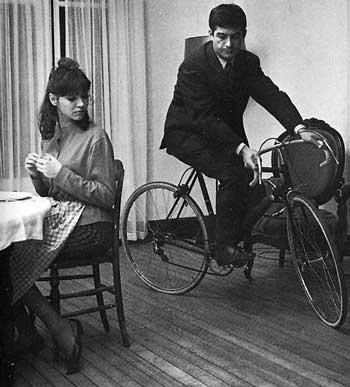
Anna Karina was then Godard’s wife and without any squabble this movie belongs to her. It is a fascinating thing to watch how Godard used her in portraying two different roles, here and in Vivra Se Vie. I can’t comment on her acting talents but surely she mesmerizes you in showcasing characters and with her screen presence. I love watching her walking into the coffee shop, passing the traffic, from the drab looking outside, ordering coffee, and leaving at the same moment. She is the face simply mimicking a vagabond, dancing with music or her malfunctioned cooking (she flips an egg, goes other room and comes back in time to catch the same on the pan) and suddenly she is urging to be a mother, the music stops, reality bites and so on.

The womanhood is also bit capricious here, as Godard depicted. Michel Legrand's orchestral score bloats time to time and disappears when Anna Karina actually sings, and the scene where the actress wishes she were in a Gene Kelly movie only marks the hurting gulf between real life and celluloid fantasy. Well, Godard was always weaned from Hollywood, no wonder. There are lots of references to other movies, for example, Jeanne Moreau wanders through in a bar and Belmondo asks her how Jules and Jim is coming!

Godard once commented he wanted to prove that comedy also can be created from close-up shots. The mercurial face of Anna Karina, her occasional slinky winks or the commitment-phobo behavior of Brialy or the hapless Belmondo illustrate a tremendous youngness and showcase the 60s French New Wave culture. Overall it is a lighter work, unlike Godard’s later outputs, but it's a narration that could well have been tragic.

Godard knew how to punch people even after forty years of his creations; well he did a lot to me.

Une femme est une femme(A Woman is a Woman - 1961)
Directed By: Jean-Luc Godard

Wednesday, December 14, 2005

Tale of Two Worlds; and a Cherry

I was introduced to the film cradle of Iran almost five years ago. Most of the movies had a common thread, minimalist show off, no luxury with any kind of tricks, offbeat stories and very elegant narration. I was fascinated by their styles; saw a bunch of movies by Makhmalbaf, Etemadi, Mehrzui, Majidi, Panahi, Karimi and Mahranfar. They are very acclaimed and highly recommended film-makers across the globe by their sheer talents, but I personally have my deepest reverence and admiration to the master Abbas Kiarostami, I must say he is the director’s director.

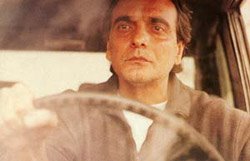
Taste of Cherry is a sublime mixture model of a fairy tale told in the simplest spirit but surrounds a complicated tug-of-war between the concepts of life and death. The way this film handles brilliantly the complex conflicts between suicide and life after, is I believe extraterrestrial to both western and eastern civilized worlds. A man, Badii (Homayoun Ershadi) is driving through the city of Tehran and traversing a winding dart road for an unknown destination. Often, desperately he pauses in the road, asks the common men to help him out form something. The story takes a while before revealing. The camera always focuses on Badii, we see his tensed frantic expression, and we surmise that he is time-bound by some distressed task. Often we see the barren lands; the dust of the roads has eaten up the greens, we are sporadically interrupted by squadrons of military troops marching up the hill performing drills.

In this strange journey Badii meets with different people on road (for detail check out IMDB), someone is from a construction site, a young soldier (who outwardly intimidated by Badii’s inquiries and reveals his apprehension that he is talking to a psycho), a safety-guard in a cement-making site, a seminarist, a Turk who works in the natural science museum as a taxidermist and so on. Badii persistently explains his predicament and seeks help from them. He is a desperate man who is actually bent on committing suicide and looking for someone to ensure at next day dawn that he is buried, dead and not alive. He is earnestly pleading for a compassionate person who will come back at six in the next morning near an isolated spot in the infertile land (a little off the road and a hole down a slope) and will throw twenty shovelfuls of dirt over his body, which will be lying in that hole! Then the person can take a hefty amount of money (which will be left at the site) and can go away.

Master auteur Kiarostami gripped this commotion perfectly. Any normal individual will behave exactly similar against Badii, as the movie portrays. Still we see there are few fundamental differences in the outlook of diversed age group. We see when Badii accosting the young soldier, he is increasingly suspicious about Badii, judging him as a madman. But the elder taxidermist or the seminarist take a different angle, they try to comprehend and sympathized to the situation more deeply and remind Badii about the Koran prohibitions, the embargo that one must not kill himself. The taxidermist also alerts Badii about his personal experience, once he was decided to commit suicide but being in a mulberry orchard, he tasted one, and the taste propounded his wish to live. He evaluated the taste of cherry with the metaphor of constructive surface of life.

In the closing stages of the movie we see at late night (or early morning) in a thunderstorm; Dabii leaves his home for his burial place. However, we don’t see actually what Badii did at his home (we see from a distance through the window that he did something, we surmise that he has taken his sleeping pill, as mentioned earlier in the movie). He drives his Rover to the hill, near the hole down the slope. Interrupted by frequent lightning we see Badii’s face, his eyes are open. They progressively go half-close, then open and close. We hear intermittent thunder sound, rainfall; occasional blacks on the screen, Badii’s face and then the screen go permanently black.

and the movie is still not over...

Well, next comes the most absorbing or intricate part of the film. We see the landscape in natural light; we see the actual shooting is taking place. We see Kiarostami, his crew and Badii too, in a different dress beside the hilly area offering a cigarette to the director. The cameraman appears, Kiarostami directs with his walkie-talkie to a distant military troop. The military take a rest beside a cherry tree. The film is now over.

No matter, how many times I swear by Taste of Cherry, I am still uncertain and hesitant about the ending. What I discover from the movie that Kiarostami addressed two vital issues here, a) is regarding the concept of suicide and b) about the dissimilar worlds of death and life after. From the side of Badii we witness Badii’s point, he is unhappy and want to be free from pain. Though Koran forbids the dictionary term “suicide” but Badii tries to clarify that being unhappy is much sinner because it also hurts those near him! So, God should have a proper reason, to free Badii from the pain. This is a very complex message. Kiarostami gives high respect to the viewers and may be that’s why he is unspoken and leaves the judgment (whether Badii is right or wrong) to us. About, the last few minutes my clues are pretty less I must say. Kiarostami demonstrated two different countenances of our worlds, one, with Badii’s death and other with the present tense. The man, Badii is still living and dissimilar as we see him in the movie. We see the squadron beside the cherry tree, Kiarostami suggested that with a single suicide or not (well, we are not sure if Badii actually died or not!), there is really no change in the society (often we see in the movie, there is an implicit hookups with the political currents of Iran).

Kiarostami never dictates the audience (though many a great directors do!) with his political curvatures or with shining glow of social messages. His films bear the utmost admiration to the individuals, to the verdict of us. That’s why his films are always haunting, more haunting in the end scenes (remember through the olive trees or the wind will carry us) as they tickle with the viewers, the viewers have to take the decisions with their individuality. Kiarostami proposes a resemblance of a rebirth through the ending of Taste of Cherry. A distinct western trumpet sound, the soldiers have stopped drilling. The audiences have to rise up from their sits (like Badii woke up from the hole of distress and now with his rebirth among us) and explain for the movie.

Ta'm e guilass (Taste of Cherry - 1997)
Directed By: Abbas Kiarostami

Thursday, December 1, 2005

Beyond the screen; a Theatrical Montage

There’s nothing left to reckon with Rashomon. Already a billion reviews have said a lot. I just try to surmise how striking the movie might have be for them who watched in the 50s for the first time! I have nothing much to review here (remembering how a deadhead once evaluated American Beauty – the flagship studio venture of the Greatful Dead, saying just in a sentence that this is the best album of all times. period.), to cut it short here is an addendum.

The woodcutter's journey through the forest, shot with a relentless tracking camera from an incredible variety of angles-high, low, back and front-and cut with axe-edge precision; the bandit's first sight of the woman as she rides by, her veil lifted momentarily by a breeze, while he loos in the shade of a tree, slapping away at mosquitoes; the striking formality of the court scene with the judge never seen at all; the scene of witchcraft with the medium whirling in a trance, and the wind blowing from two opposite directions at the same time...

This excerpt is from the book Our Films Their Films by Satyajit Ray. When the master thought so, do I need to say more?

Rashomon haunts me like it does to a million souls. Above all, I have been haunted by the theatrical narration and techniques of the staging. It is an electric movie and a dazzling proof of a director’s command on every aspects of film making. The movie has so many folds within and the way virtuoso Kurosawa brings out all the layers of the film with its aural and visual richness; no doubt Rashomon has to be listed in any film buffs recipe book.

In my dream I write a silent rendition of Rashomon in my mother tongue.

Rashomon (1950)
Directed By : Akira Kurosawa

A Divine Redemption

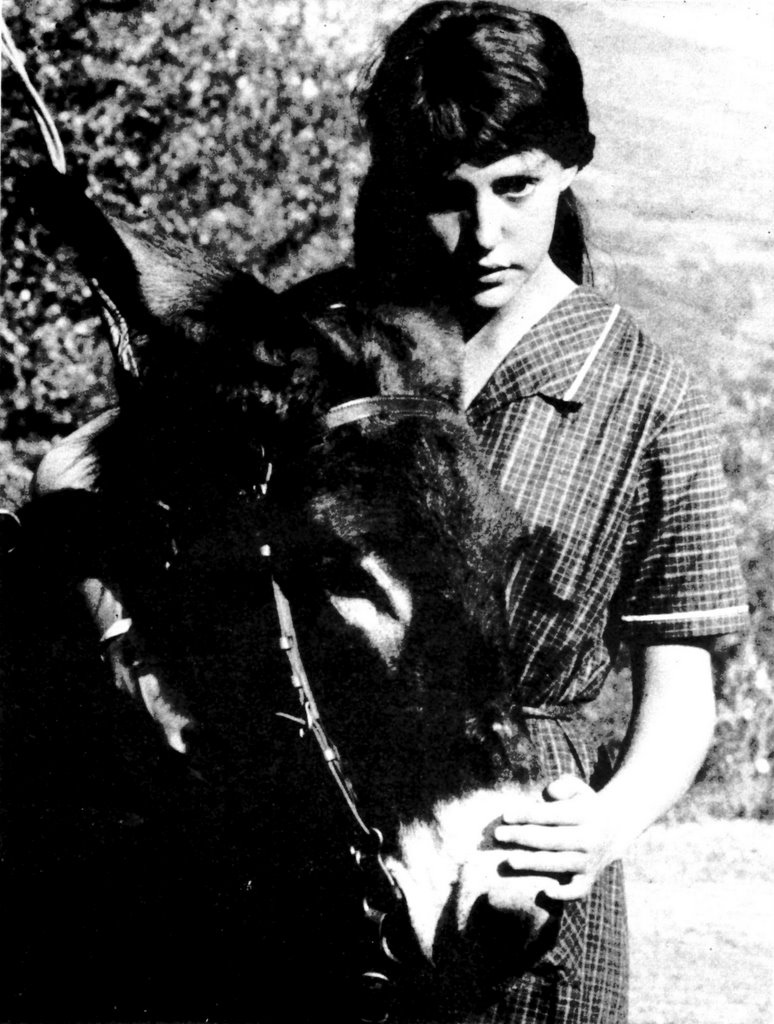
The protagonist of Au Hasard Balthazar is essentially a donkey. It is a trained donkey and passes through all the mistreated mundane possible episodes in a donkey’s life. It is noble and ignorable, changes hands repeatedly, sometimes well treated sometimes abused and without attentions, carrying loads in rural France or used for trespassing with illegal goods. With these so called a beast of burdens Bresson creates a sublime metaphor for the human condition. There is Maria (Anne Wiazemsky), a peasant girl who also goes through a series of sufferings, a gloomy friendless childhood and a silent witness to mankind's vices and injustices. In they end, however they achieve spiritual redemption.

Some critics cited that Bresson was inspired by Dostoevyski’s The Idiot. With his religious background he created an uplifting fusion between both. The donkey is a symbol of a moron and sometimes a symbol of the uplifted soul (in Bible there are numerous occurrences where the donkey is used as an enlighten one).

Bresson has a unique way to capture the characters. His deep aversion to actors or any camera tricks, shooting “ears” or “hands” or “back of legs” than a human face or the whole human body, creating a meddle between Schubert’s piano sonatas and Balthazar’s braying, are just few hypnotic trances in the movie. There are so many poetic juggleries in the movie that it is difficult to pen down all. From my memory I cannot forget the most morbid but beautiful scene where Maria in a nocturnal reunion with Balthazar, caressing the flower-crowned head of him, before an ill-fated meeting with the thug Gerard. Maria is paying some kind of obligations to Balthazar with most of her spirit, as she knows the donkey is finally the icon who will be crucified.

Critics have commented a lot about the last shot of the film. It is an austere aesthetic and blessed scene. We see a long-suffering wounded Balthazar is crippling in pain and wrinkles to death among a herd of sheep. In accord with the beginning, we remember how the baby Balthazar was born and baptized in an utopian world with a belled sheep grazing in the background. Endlessly we see the donkey is crumpling in pain and sooner the accumulated pains of life releases with his dying. Balthazar carries our sins as a burden and discharges them in a most divine shot of movie history.

Au hazard Balthazar is cited as one of the greatest movie experiences of 21th century. No wonder why Godard called this masterpiece as Bresson’s “most complete” effort. The movie is a search of purity, a trip to sainthood; it leads to a greater meaning of our existence on planet earth.

Au Hasard Balthazar ( 1966)
Directed By : Robert Bresson

Friday, November 18, 2005

the Morning Comforts

La Notte is the sophomore effort of the proverbial
trilogy (L’ Avventura, La Notte and L’ Eclisse) crafted by Antonioni. Though the trilogy essentially not having a pet name resembling the memorable “Apu-trilogy” or so, but all three are connected in a same string of troubled relationship set in the lyrically stunning architectural backgrounds, whether beautiful immense nature or pleasant glamorized 60’s urban Italy.

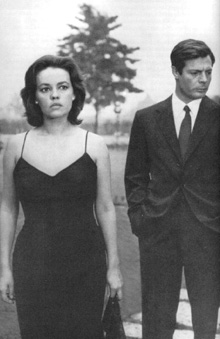
La Notte has a little plot to speak of. Antonioni follows Lidia (Jeanne Moreau, more celebrated in portraying the role of Catherina in Truffaut’s surrealistic masterpiece Jules et Jim) and her husband, the renowned author Giovanni (Mastroianni) in a course of a single day and night. They visit their friend Tommaso who is dying in the hospital. They wander the busy streets of Milan, attend promotional party of Giovanni’s latest book, visit clubs and attend one more party organized by a rich millionaire in night and finally they confront the cold apathy that has expanded among them. Both rebuff any sexual advances of the unknown, but they perform so only out of obligatory respects. In the next day, at dawn Lidia and Giovanni separate themselves from the crowd of barmy party-goers and make their way down a large empty field of a golf course.

They discuss their marriage in equal doses of resentment, and denial, but finally admit that their love has atrophied. Lydia accuses Giovanni for the emaciated affection but he becomes emotional, perhaps the confrontation forces him to suddenly feel a tinge fondness towards her, somehow. In a fit of passion he lunges toward her while she whispers in the screen that she wants to hear that he does not love her. Antonioni frames the vast emptiness of the field and leaves the audience in with little hope for comfort to predict their future.

The minimalist usage of symbols in Antonioni’s ventures is too commendable. From the very beginning he captures vast architectural buildings of Milan, the high rise, the chemistry of geometrical figures. This is much different from L’ Avventura yet we find a similarity in capturing large architectures as backgrounds. Antonioni repeatedly composes Lidia from different angles and communicates with the viewer. She is leaning toward walls with her vacuous interaction with life; she is walking no-direction-home or stares out from the hospital window to watch a sudden glimpse of a helicopter thus alienating her composition from her surroundings. With a microscopic detailing we see Lidia stands alone wherever and throughout the remainder of the film.

Few shots I should point out before I pause. After the millionaire throws the offer to Giovanni for a permanent job in his organization we follow the raucous party guests with a short spell framing an aviary and a bird. We recall the whole setup of the evening party and we see that numerous instances of creating patterns of vertical strong lines or series of horizontal blocks with shadows. Antonioni counter balances his compositions with these hurdles between withered relations in the premonition of a new industrial Italy.

La Notte is another aesthetically complex but critically stimulating movie.

La Notte (The Night -1961)
Directed By: Michelangelo Antonioni

Wednesday, November 16, 2005

Long Strange Trip...

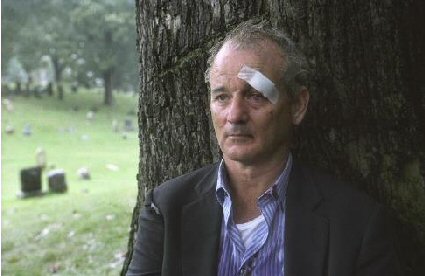
Earnestly single Don Johnston (portrayed by Bill Murray) is dumped by his latest girlfriend (three color famed Julie Delphi) and receives a weird pink letter from his unknown son, same time. The letter addresses that his child (!) is looking for him and on an assignment to find him. Distressed by the letter (but not showing outwardly) Don seeks help from his neighbor Winston, an upcoming amateur sleuth. Rather than following the “move on” motto of life, Don tries to simulate a cross-country inspection on his old flames to resolve the anonymity of the nameless mail, to discover the origin of the letter and if he actually possesses a son or not.

Broken Flowers does not talk about relationship or bondages, though the name might imitates it. It is a brilliant adventure in a protagonist’s past to check the mile posts in the nostalgic trip. Bill Murray rules the screen superbly; he is uninterested in face about this weird situation but diligent inside to find someone who wrote the mail. The panoramas where Bill is sitting unaccompanied in his room in a dark evening and listening music are profoundly quest about his perpetual bachelorhood. Or it asks about any single man or woman in the world about their times. Don is ignorant of all the actuality, yet he is meticulously following Winston’s advices in carrying the itinerary, the same CD or following the norm of meeting his previous girl friends with a bouquet of pink flowers.

This movie must have been planned with Bill Murray in mind. I am still a novice to Jarmusch (Coffee & Cigarettes and Ghost Dog: the Way of the Samurai) but his signature usage of split humors or dramatic urgency are very much present here. The experience of Bill while revisiting his past is sometimes good and sometimes bitter & hostile but it is finally in search of something more eternal and true. Jarmusch wants Murray's Don to be a quiet observer to his misspent life suspended in front of him, but almost unable to fundamentally communicate to them. Murray is typically incredible here, quiet yet delicately expressive, and surrounded by an impressive collection of leading ladies to play off of. Jarmusch’s minimal use of Don’s expression is unparallel. Dejected by the recent ventures, but Don already started believing in the existence of his son. Murray perfectly portrayed the confusion or in search of happiness while believing in the existence of the unknown.

The movie does not offer you sorta happy-ending to cherish in your bag pack and to put under your pillow for a sweet lullaby, but perhaps that’s very much true with many a life stories.

Sometimes life offers you just some broken flowers.

Broken Flowers (2005)
Directed By - Jim Jarmusch