Wednesday, December 28, 2005

A Close-Up Comedy?

A woman is a woman is a sandwich venture of Godard between his breathtaking debut in A bout de soufflé (Breathless) and the tragic classic Vivra Se Vie (My life to live) and I still wonder how all these three are different in all aspects. Godard was always uninhibited, lighthearted, and purposefully slapdash in style (as Ray commented once) but was a true experimental mind. He mastered the true sense of being wild in movie, and his intellects, playfulness with the audience and the characters are always worth mentioning.

I wont keep A woman is a woman in the league of Vivra Se Vie, A bout de soufflé, Masculine Feminine, Weekend or probably not in the group of Alphaville or Two or Three Things I Know About Her. But still it’s a must watch for his analytical views on being childish in one hand and imitating Hollywood musicals in the other. He created a perfect crescendo of conflicts between reality and the musical world (that is the fantasy world) which, sometimes feel as undistinguishable. After the movie finishes, I was wondering is it a comedy or a premonition of a tragic beginning? But, whatever, as critics and fans comment, this was the last time Godard was having fun!

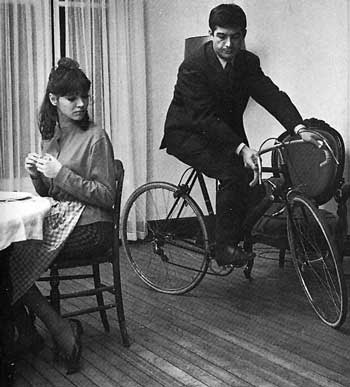
Anna Karina was then Godard’s wife and without any squabble this movie belongs to her. It is a fascinating thing to watch how Godard used her in portraying two different roles, here and in Vivra Se Vie. I can’t comment on her acting talents but surely she mesmerizes you in showcasing characters and with her screen presence. I love watching her walking into the coffee shop, passing the traffic, from the drab looking outside, ordering coffee, and leaving at the same moment. She is the face simply mimicking a vagabond, dancing with music or her malfunctioned cooking (she flips an egg, goes other room and comes back in time to catch the same on the pan) and suddenly she is urging to be a mother, the music stops, reality bites and so on.

The womanhood is also bit capricious here, as Godard depicted. Michel Legrand's orchestral score bloats time to time and disappears when Anna Karina actually sings, and the scene where the actress wishes she were in a Gene Kelly movie only marks the hurting gulf between real life and celluloid fantasy. Well, Godard was always weaned from Hollywood, no wonder. There are lots of references to other movies, for example, Jeanne Moreau wanders through in a bar and Belmondo asks her how Jules and Jim is coming!

Godard once commented he wanted to prove that comedy also can be created from close-up shots. The mercurial face of Anna Karina, her occasional slinky winks or the commitment-phobo behavior of Brialy or the hapless Belmondo illustrate a tremendous youngness and showcase the 60s French New Wave culture. Overall it is a lighter work, unlike Godard’s later outputs, but it's a narration that could well have been tragic.

Godard knew how to punch people even after forty years of his creations; well he did a lot to me.

Une femme est une femme(A Woman is a Woman - 1961)
Directed By: Jean-Luc Godard

Wednesday, December 14, 2005

Tale of Two Worlds; and a Cherry

I was introduced to the film cradle of Iran almost five years ago. Most of the movies had a common thread, minimalist show off, no luxury with any kind of tricks, offbeat stories and very elegant narration. I was fascinated by their styles; saw a bunch of movies by Makhmalbaf, Etemadi, Mehrzui, Majidi, Panahi, Karimi and Mahranfar. They are very acclaimed and highly recommended film-makers across the globe by their sheer talents, but I personally have my deepest reverence and admiration to the master Abbas Kiarostami, I must say he is the director’s director.

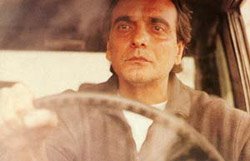
Taste of Cherry is a sublime mixture model of a fairy tale told in the simplest spirit but surrounds a complicated tug-of-war between the concepts of life and death. The way this film handles brilliantly the complex conflicts between suicide and life after, is I believe extraterrestrial to both western and eastern civilized worlds. A man, Badii (Homayoun Ershadi) is driving through the city of Tehran and traversing a winding dart road for an unknown destination. Often, desperately he pauses in the road, asks the common men to help him out form something. The story takes a while before revealing. The camera always focuses on Badii, we see his tensed frantic expression, and we surmise that he is time-bound by some distressed task. Often we see the barren lands; the dust of the roads has eaten up the greens, we are sporadically interrupted by squadrons of military troops marching up the hill performing drills.

In this strange journey Badii meets with different people on road (for detail check out IMDB), someone is from a construction site, a young soldier (who outwardly intimidated by Badii’s inquiries and reveals his apprehension that he is talking to a psycho), a safety-guard in a cement-making site, a seminarist, a Turk who works in the natural science museum as a taxidermist and so on. Badii persistently explains his predicament and seeks help from them. He is a desperate man who is actually bent on committing suicide and looking for someone to ensure at next day dawn that he is buried, dead and not alive. He is earnestly pleading for a compassionate person who will come back at six in the next morning near an isolated spot in the infertile land (a little off the road and a hole down a slope) and will throw twenty shovelfuls of dirt over his body, which will be lying in that hole! Then the person can take a hefty amount of money (which will be left at the site) and can go away.

Master auteur Kiarostami gripped this commotion perfectly. Any normal individual will behave exactly similar against Badii, as the movie portrays. Still we see there are few fundamental differences in the outlook of diversed age group. We see when Badii accosting the young soldier, he is increasingly suspicious about Badii, judging him as a madman. But the elder taxidermist or the seminarist take a different angle, they try to comprehend and sympathized to the situation more deeply and remind Badii about the Koran prohibitions, the embargo that one must not kill himself. The taxidermist also alerts Badii about his personal experience, once he was decided to commit suicide but being in a mulberry orchard, he tasted one, and the taste propounded his wish to live. He evaluated the taste of cherry with the metaphor of constructive surface of life.

In the closing stages of the movie we see at late night (or early morning) in a thunderstorm; Dabii leaves his home for his burial place. However, we don’t see actually what Badii did at his home (we see from a distance through the window that he did something, we surmise that he has taken his sleeping pill, as mentioned earlier in the movie). He drives his Rover to the hill, near the hole down the slope. Interrupted by frequent lightning we see Badii’s face, his eyes are open. They progressively go half-close, then open and close. We hear intermittent thunder sound, rainfall; occasional blacks on the screen, Badii’s face and then the screen go permanently black.

and the movie is still not over...

Well, next comes the most absorbing or intricate part of the film. We see the landscape in natural light; we see the actual shooting is taking place. We see Kiarostami, his crew and Badii too, in a different dress beside the hilly area offering a cigarette to the director. The cameraman appears, Kiarostami directs with his walkie-talkie to a distant military troop. The military take a rest beside a cherry tree. The film is now over.

No matter, how many times I swear by Taste of Cherry, I am still uncertain and hesitant about the ending. What I discover from the movie that Kiarostami addressed two vital issues here, a) is regarding the concept of suicide and b) about the dissimilar worlds of death and life after. From the side of Badii we witness Badii’s point, he is unhappy and want to be free from pain. Though Koran forbids the dictionary term “suicide” but Badii tries to clarify that being unhappy is much sinner because it also hurts those near him! So, God should have a proper reason, to free Badii from the pain. This is a very complex message. Kiarostami gives high respect to the viewers and may be that’s why he is unspoken and leaves the judgment (whether Badii is right or wrong) to us. About, the last few minutes my clues are pretty less I must say. Kiarostami demonstrated two different countenances of our worlds, one, with Badii’s death and other with the present tense. The man, Badii is still living and dissimilar as we see him in the movie. We see the squadron beside the cherry tree, Kiarostami suggested that with a single suicide or not (well, we are not sure if Badii actually died or not!), there is really no change in the society (often we see in the movie, there is an implicit hookups with the political currents of Iran).

Kiarostami never dictates the audience (though many a great directors do!) with his political curvatures or with shining glow of social messages. His films bear the utmost admiration to the individuals, to the verdict of us. That’s why his films are always haunting, more haunting in the end scenes (remember through the olive trees or the wind will carry us) as they tickle with the viewers, the viewers have to take the decisions with their individuality. Kiarostami proposes a resemblance of a rebirth through the ending of Taste of Cherry. A distinct western trumpet sound, the soldiers have stopped drilling. The audiences have to rise up from their sits (like Badii woke up from the hole of distress and now with his rebirth among us) and explain for the movie.

Ta'm e guilass (Taste of Cherry - 1997)
Directed By: Abbas Kiarostami
Thursday, December 1, 2005

Beyond the screen; a Theatrical Montage

There’s nothing left to reckon with Rashomon. Already a billion reviews have said a lot. I just try to surmise how striking the movie might have be for them who watched in the 50s for the first time! I have nothing much to review here (remembering how a deadhead once evaluated American Beauty – the flagship studio venture of the Greatful Dead, saying just in a sentence that this is the best album of all times. period.), to cut it short here is an addendum.

The woodcutter's journey through the forest, shot with a relentless tracking camera from an incredible variety of angles-high, low, back and front-and cut with axe-edge precision; the bandit's first sight of the woman as she rides by, her veil lifted momentarily by a breeze, while he loos in the shade of a tree, slapping away at mosquitoes; the striking formality of the court scene with the judge never seen at all; the scene of witchcraft with the medium whirling in a trance, and the wind blowing from two opposite directions at the same time...

This excerpt is from the book Our Films Their Films by Satyajit Ray. When the master thought so, do I need to say more?

Rashomon haunts me like it does to a million souls. Above all, I have been haunted by the theatrical narration and techniques of the staging. It is an electric movie and a dazzling proof of a director’s command on every aspects of film making. The movie has so many folds within and the way virtuoso Kurosawa brings out all the layers of the film with its aural and visual richness; no doubt Rashomon has to be listed in any film buffs recipe book.

In my dream I write a silent rendition of Rashomon in my mother tongue.

Rashomon (1950)
Directed By : Akira Kurosawa

A Divine Redemption

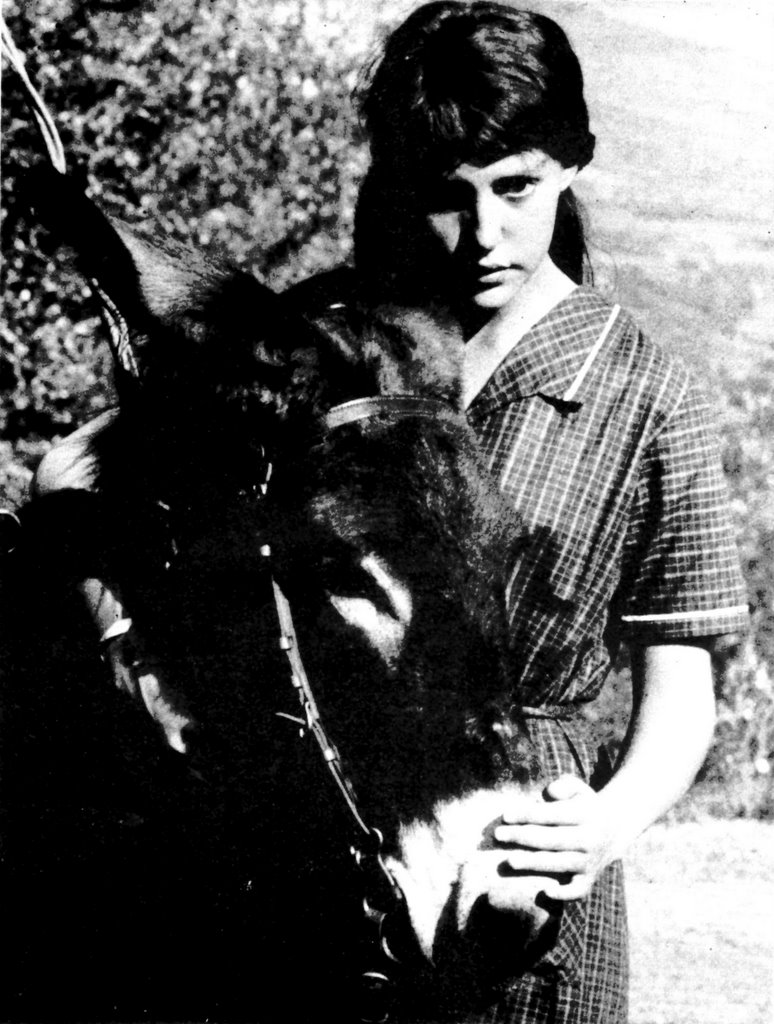
The protagonist of Au Hasard Balthazar is essentially a donkey. It is a trained donkey and passes through all the mistreated mundane possible episodes in a donkey’s life. It is noble and ignorable, changes hands repeatedly, sometimes well treated sometimes abused and without attentions, carrying loads in rural France or used for trespassing with illegal goods. With these so called a beast of burdens Bresson creates a sublime metaphor for the human condition. There is Maria (Anne Wiazemsky), a peasant girl who also goes through a series of sufferings, a gloomy friendless childhood and a silent witness to mankind's vices and injustices. In they end, however they achieve spiritual redemption.

Some critics cited that Bresson was inspired by Dostoevyski’s The Idiot. With his religious background he created an uplifting fusion between both. The donkey is a symbol of a moron and sometimes a symbol of the uplifted soul (in Bible there are numerous occurrences where the donkey is used as an enlighten one).

Bresson has a unique way to capture the characters. His deep aversion to actors or any camera tricks, shooting “ears” or “hands” or “back of legs” than a human face or the whole human body, creating a meddle between Schubert’s piano sonatas and Balthazar’s braying, are just few hypnotic trances in the movie. There are so many poetic juggleries in the movie that it is difficult to pen down all. From my memory I cannot forget the most morbid but beautiful scene where Maria in a nocturnal reunion with Balthazar, caressing the flower-crowned head of him, before an ill-fated meeting with the thug Gerard. Maria is paying some kind of obligations to Balthazar with most of her spirit, as she knows the donkey is finally the icon who will be crucified.

Critics have commented a lot about the last shot of the film. It is an austere aesthetic and blessed scene. We see a long-suffering wounded Balthazar is crippling in pain and wrinkles to death among a herd of sheep. In accord with the beginning, we remember how the baby Balthazar was born and baptized in an utopian world with a belled sheep grazing in the background. Endlessly we see the donkey is crumpling in pain and sooner the accumulated pains of life releases with his dying. Balthazar carries our sins as a burden and discharges them in a most divine shot of movie history.

Au hazard Balthazar is cited as one of the greatest movie experiences of 21th century. No wonder why Godard called this masterpiece as Bresson’s “most complete” effort. The movie is a search of purity, a trip to sainthood; it leads to a greater meaning of our existence on planet earth.

Au Hasard Balthazar ( 1966)
Directed By : Robert Bresson

Friday, November 18, 2005

the Morning Comforts

La Notte is the sophomore effort of the proverbial
trilogy (L’ Avventura, La Notte and L’ Eclisse) crafted by Antonioni. Though the trilogy essentially not having a pet name resembling the memorable “Apu-trilogy” or so, but all three are connected in a same string of troubled relationship set in the lyrically stunning architectural backgrounds, whether beautiful immense nature or pleasant glamorized 60’s urban Italy.

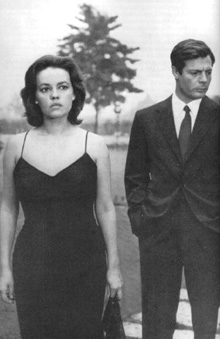
La Notte has a little plot to speak of. Antonioni follows Lidia (Jeanne Moreau, more celebrated in portraying the role of Catherina in Truffaut’s surrealistic masterpiece Jules et Jim) and her husband, the renowned author Giovanni (Mastroianni) in a course of a single day and night. They visit their friend Tommaso who is dying in the hospital. They wander the busy streets of Milan, attend promotional party of Giovanni’s latest book, visit clubs and attend one more party organized by a rich millionaire in night and finally they confront the cold apathy that has expanded among them. Both rebuff any sexual advances of the unknown, but they perform so only out of obligatory respects. In the next day, at dawn Lidia and Giovanni separate themselves from the crowd of barmy party-goers and make their way down a large empty field of a golf course.

They discuss their marriage in equal doses of resentment, and denial, but finally admit that their love has atrophied. Lydia accuses Giovanni for the emaciated affection but he becomes emotional, perhaps the confrontation forces him to suddenly feel a tinge fondness towards her, somehow. In a fit of passion he lunges toward her while she whispers in the screen that she wants to hear that he does not love her. Antonioni frames the vast emptiness of the field and leaves the audience in with little hope for comfort to predict their future.

The minimalist usage of symbols in Antonioni’s ventures is too commendable. From the very beginning he captures vast architectural buildings of Milan, the high rise, the chemistry of geometrical figures. This is much different from L’ Avventura yet we find a similarity in capturing large architectures as backgrounds. Antonioni repeatedly composes Lidia from different angles and communicates with the viewer. She is leaning toward walls with her vacuous interaction with life; she is walking no-direction-home or stares out from the hospital window to watch a sudden glimpse of a helicopter thus alienating her composition from her surroundings. With a microscopic detailing we see Lidia stands alone wherever and throughout the remainder of the film.

Few shots I should point out before I pause. After the millionaire throws the offer to Giovanni for a permanent job in his organization we follow the raucous party guests with a short spell framing an aviary and a bird. We recall the whole setup of the evening party and we see that numerous instances of creating patterns of vertical strong lines or series of horizontal blocks with shadows. Antonioni counter balances his compositions with these hurdles between withered relations in the premonition of a new industrial Italy.

La Notte is another aesthetically complex but critically stimulating movie.

La Notte (The Night -1961)
Directed By: Michelangelo Antonioni

Wednesday, November 16, 2005

Long Strange Trip...

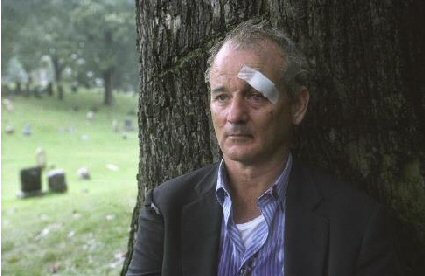
Earnestly single Don Johnston (portrayed by Bill Murray) is dumped by his latest girlfriend (three color famed Julie Delphi) and receives a weird pink letter from his unknown son, same time. The letter addresses that his child (!) is looking for him and on an assignment to find him. Distressed by the letter (but not showing outwardly) Don seeks help from his neighbor Winston, an upcoming amateur sleuth. Rather than following the “move on” motto of life, Don tries to simulate a cross-country inspection on his old flames to resolve the anonymity of the nameless mail, to discover the origin of the letter and if he actually possesses a son or not.

Broken Flowers does not talk about relationship or bondages, though the name might imitates it. It is a brilliant adventure in a protagonist’s past to check the mile posts in the nostalgic trip. Bill Murray rules the screen superbly; he is uninterested in face about this weird situation but diligent inside to find someone who wrote the mail. The panoramas where Bill is sitting unaccompanied in his room in a dark evening and listening music are profoundly quest about his perpetual bachelorhood. Or it asks about any single man or woman in the world about their times. Don is ignorant of all the actuality, yet he is meticulously following Winston’s advices in carrying the itinerary, the same CD or following the norm of meeting his previous girl friends with a bouquet of pink flowers.

This movie must have been planned with Bill Murray in mind. I am still a novice to Jarmusch (Coffee & Cigarettes and Ghost Dog: the Way of the Samurai) but his signature usage of split humors or dramatic urgency are very much present here. The experience of Bill while revisiting his past is sometimes good and sometimes bitter & hostile but it is finally in search of something more eternal and true. Jarmusch wants Murray's Don to be a quiet observer to his misspent life suspended in front of him, but almost unable to fundamentally communicate to them. Murray is typically incredible here, quiet yet delicately expressive, and surrounded by an impressive collection of leading ladies to play off of. Jarmusch’s minimal use of Don’s expression is unparallel. Dejected by the recent ventures, but Don already started believing in the existence of his son. Murray perfectly portrayed the confusion or in search of happiness while believing in the existence of the unknown.

The movie does not offer you sorta happy-ending to cherish in your bag pack and to put under your pillow for a sweet lullaby, but perhaps that’s very much true with many a life stories.

Sometimes life offers you just some broken flowers.

Broken Flowers (2005)
Directed By - Jim Jarmusch

Tuesday, October 4, 2005

Marx and Coke

We control our thoughts which mean nothing, and not our emotions which mean everything.
~Masculin/Feminin

The central character Paul just returned from military service, disillusioned and trying to take a profession in either writing or doing something significant. He meets the “wanna be” pop singer Madeleine in a coffee shop and the film rolls on. Masculin/Feminin is an absorbing essay digest on the 60’s French young people dealing with value judgment, political views and daily existences. The unfolding is flamboyant, often with ingredients of documentary attributes, deliberately created by Godard. This film adds factors to the implicit commotion between political biasness and emerging pop culture (!) among young French guys in 60’s. Actually, this film can be showcased as Godard’s early approaches towards political movies or as a surface premonition of his later day’s anti-bourgeois contents.

The narration is elegant; there are few moments of long chat scenes, in which Godard can be regarded as a mastermind. He focuses on the protagonist’s off-dialogues; sometimes he fashions the audience as a part of the discussion by changing the focal points from person to person and suddenly spotlighting only one person for long. The discourses are also pretty cerebral, though I have grumble towards the DVD subtitles here, sometimes I felt the English captions are not coagulating properly (“deliver us from liberty?”).

There are few master strokes in the long interview shots, individuals are been interviewed throughout the movie, sometimes with repeated queries. Questions on politics, or suddenly jumping to topics of Pepsi or Vietnam War (Dylan in quoted as a Vietnik (Vietnam + Beatnik). Godard as always dismantles the predictive form of film narrating, by suitably inserting captions, titles, iconoclastic images (the death scene of liberty in the guillotine), bucketing dilemmas and insecure self-identification of French people caught in the middle of pop and Bach.

Is Godard sexist? Perhaps his remark on “masculin” word (“there is a mask in the word”) and “feminin” (“the word feminin has nothing...”) may protract this argument. Also, in the end Madeleine comments that she knows nothing, there is a big stress on the word “nothing”. Is this nothing has to do anything with Godard’s hesitant attitude towards pop culture and bourgeois?

Perhaps, the turbulence of 60’s can be best described in a slogan of the movie. The movie can be re titled as “the children of Marx and Coca-Cola”!

Children of a lesser god?

Masculin, féminin: 15 faits précis
( Masculin/Feminin -1966)

Directed By: Jean-Luc Godard

Saturday, October 1, 2005

Living the life...

My life to live is an unnatural cinematic experience. This is a movie not only about style and intelligent film making; it is more about the ongoing commotions of delving into values of life and pathos. Godard, one of the most cerebral movie makers of all time (perhaps, his contributions can be summed by a single critical comment, that his worst movie is also so stylish and revolutionary, can be seen many a times and beat hands down other celebrated movies) is at his zenith, for my personal opinion just for my live to live, he can be remembered through space-time.

The main protagonist Nana, (portrayed by the amazing Anna Karina) is a stunning naïve young woman, who is in the search of joy and meaning of happiness and freedom in life. She has left her family and tries to take an acting profession but ends up in being a prostitute. The film starts in a coffee shop, Nana and her boy friend Paul having an uneasy conversation. Godard’s proverbial camerawork follows the scene from uncanny and uncomfortable angles depicting the turmoil of their affiliation and the emotional distance between them. From this shot, we follow the beautiful narration of the movie by seeing numerous times the dismayed and suffered face of Nana. Godard splits the movie into twelve tableaux, with very significant sub-headings. This unformulated adaptation of creating different sections for the movie been used to show different layers of Nana’s different personas, uncomprehending agony and run for freedom. The camera follows her face from various angles, stunning long shots showing the turbulent, lost and desperate countenance of Nana. She is a sensitive person, emotionally breaks down while watching Maria Falconetti in “Passion of Joan of Arc” (a classic from Dreyer). She sees herself in Joan of Arc’s role, tries to come out from the sordid mundane lifestyle of her, to achieve something more bigly.

Godard personally has put up few questions with this using of mazes in the film. We see a photographer takes a little interest in Nana to give her a chance to enter into film world. Soon we see Nana meets a pimp who imitates the photographer. Are both professions replicas of each other?

I cannot forget the mesmerizing scene of Nana’s free flow dance while playing the juke box. Relentlessly, she moves and dances beside the pool tables, just as a weightless cloud. It is a very short fleeting glimpse of happiness and joy in her life, she has ever known. Such a brief but fresh air brought by the scene! You will feel deeply how truly she is desperate to find out bits and bytes of cheerfulness from the banality of life.

In the end wee see a petite scene while Nana consorting with a guy, just after her degraded and discarded experience. This guy reads a story of Poe which ends with the death of the artist’s love. Similarly, Nana’s life is also judged by mankind and experience a sudden tragic end, resembling the character of Joan of Arc.

Godard was the part of French New Wave of filmmaking, and this is one of the finest austere moments of movie history. He creates layers of layers of Nana’s vacuous and empty lifestyle and brings a shocking unexpected conclusion. Perhaps, there was nothing left to articulate her pains. This is one finest instance in films to fashion perfect characters, no matter how much you taint her, but you will always memorize the mournful but hopeful expressions of her. It is a remarkable film, a ballad of the director’s own doubts on today’s world blended with desolations and sufferings of human life.

My life to live is an astonishing fable of an existing tragedy.

Vivre sa vie: Film en douze tableaux
(My Life to Live -1962)

Directed By: Jean Luc-Godard

Thursday, September 29, 2005

Fatal Obsession

I favor Buñuel for countless motivations. Not only his surrealistic politics and instant unfolding of storyline haunts me or the surface layers of sardonic satires taunts me a large, I adore his practice of symbols and signs. They are so implicit yet spectacular that a viewer always left with choices to delve much into the usage of the icons or not. Unlike Fellini or Tarkovsky, where these masters fashion an image “out of the world” to savor, for example, the usage of a man flying as a kite (in 8 ½ of Fellini) or the baffling representations of post-wars (in Mirror of Tarkovsky) Buñuel is always too unspoken and crafts lucid imagery of mundane objects to represent the dialects of his movies.

Well, “that obscure object of desire”, the last endeavor of Buñuel is also belongs to the same school of master filmmaking. His undying portraying of the puzzles of sexual politics and turbulence is the chief facet of the movie. Buñuel deposits a labyrinth of Mathieu’s (Fernando Rey) perplexities and desires with his relationship with Conchita (Carole Bouquet and Angela Molina). The affiliation is perennially thwarted by continuous break-ups and re-associations. Buñuel masterly created two countenances of Conchita as in two sides of the same coin. The protagonist Mathieu is deeply confused and threaten by abrupt, disordered and erratic behaviors of Conchita, the viewers are mystified as there are two actresses continuously interchanging the role of Conchita! With one Conchita we constantly see some kind of dilemmas and troublesome incidents, like terrorist activities, car bombing or explosions. In one word, continuous hazards from the outer world, but the hypnotized Mathieu does not noticed this that the world around him falling apart. The other Conchita is always having some clarifications of her inconsistent behaviors and there is some type of flavor of reconcilement. Both Conchita are used to convey different emotions, and the requirement of any Conchita is governed by the narration. This usage of two actresses for a leading role brings out the intricacy of Conchita, makes Mathieu so spellbound that he is unaware of the dissimilarity between these two women. He does not comprehend the character, so his all ammunitions of winning a woman (kindness, money, gift or even with brute force) fail miserably and his perceptions of captivating someone is confounded by her unremitting rejection and re-settlements.

Buñuel enthralls the audience by his sheer gripping of human psychology here. Mathieu is so desperately obsessed and gripped by Conchita, he trusts her completely and stands by her explanations of her behaviors, how mismatched or inconsistent they would be. Truly obsession sometimes misguide you, block your visions. That’s why Mathieu is ignorant of the fact that there are two appearances of Conchita (but there is one existence of her) alongside him in different shots, but he is so oblivious and obsessed understanding this is beyond him.

The final scene shows the reunited couple once more, standing behind the glass wall of a lace shop window, a woman is suing the lace of Conchita’s blood shed dress. Is the director sewing the scenes or their relation? But this testament is again spoiled by their silent arguing and a sudden bomb explosion.

This is a prime time evidence of sheer medley of imageries, surrealistic symbolism and deep commotions between sexual politics.

Cet obscur objet du désir
(That Obscure Object of Desire -1977)

Directed By: Luis Buñuel

Thursday, September 22, 2005

Time destroys everything

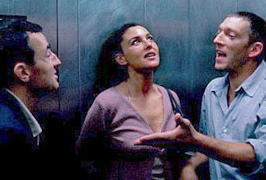
If you assume this film also in the league of movies which disrespect the clockwise time flow (aka Tarantino or González Iñárritu style) you will commit a big blunder. We have seen movies which go fast forward or come back, or toil with asynchronous modules, meeting at a crossroad and then again move or thrust the reverse gear. Irreversible does not bother about these zigzag movements, however it flows in a counter clockwise fashion. There are nine to ten sequences in the movie, and all events are brought up by the previous sequence. All current events are actually descendant of the past occurrences.

Much ado been addressed to the gory violent and explicit initial scenes of the movie. They are gruesome and of course there are realistic reasons behind people move off theatre during the showing of Irreversible. To make you more disturbed and agitated Gasper Noé played an irritating tune in a very low decibel for the first half of the movie, as an added element to offer you a feeling of nausea. With these, again there is the whirling and spinning fast camerawork to give you a raw annoying feeling.

The proverbial tagline “time destroys everything” is purely synonymous with the film. What we experience in Irreversible is not only breaking the laws of time movement, but as time progresses in the events of the movie, it degrades. Time is a killer, not a healer here. Time takes the ingredients of “now” and in return we see a horrific “then”. As the storyline begins, we see everything in a chaos. We see the chief protagonists of the movie whose emotions are breaching from their past behaviors and merciless brutality ruling their mind. The psyche of the movie goes parallel with the characters. The camera spins a lot, the characters twirl and we see everything are unbalanced and out of control, analogous to the movie. It is completely dark, lots of murky symbols and signs.

As the movie progresses, the story unfolds in the opposite direction, and we see how brilliantly the director regulates the control of movie making. The audience feels the personal despair in every shot, as they are well aware of the facts what hardhearted fate is coming in the next shot but no one can control the motion of time and us. The movie offers you better scenes than just before what you see. Colorful, cheerful elements are embracing life, protagonists are bartering jokes, people are partying, and kids are playing.

The end shot is a masterpiece. Bellucci is resting in a park and kids are playing with water valve. There is Beethoven’s seventh symphony in ambience, everything beside us so vibrant and smug in happiness. The camera lifts up and suddenly starts rolling, yet once more in an anti clockwise route. You see everything rolling down in an opposite way and the screen collapses in total white background.

Irreversible leaves you with many unanswered questions. Are we really puppet in the arms of time? Is there really a vicious and evil mask is hidden under our face which might recuperate anytime? Is everything really pre-defined and we are walking on the thin strip of chances?

A must must watch for any strict film buff. A must must not recommended else.

Irreversible (2002)
Directed By:
Gasper Noé

Monday, August 29, 2005

the Story of Us

An elderly couple from the town of Onomichi traveling to the contemporary city of Tokyo, to congregate with their children, to spend time with them in Tokyo. In return they are sidelined by the children, as they are busy with their selfishness or to say in a proverbial tone, the time demands them to be like this. Only their widowed daughter-in-law seems genuinely pleased to see them, takes a day off from her job and expends a day with the couple for sight seeing. The couple leaves Tokyo and the audience faces the fractured countenance of culture, tradition and generations, overruled by modernization and self-absorbed consumerism.

This is an effortless languidly paced yet poignant story of mankind. Nothing is spectacular but the film spreads its wings slowly in a quite customary grace, with its mundane dialogues, undemanding mannerism, and subtle gestures. Without any external mechanism Ozu creates an environment of the familiar family structure around the viewers. We Indians might find resemblance of this story with a zillion other Indian narrations, in movies, theatres or novels etc. but in Tokyo Story, nothing is overcooked, there is no peripheral catalyst to ask about or to show reasons for the dysfunctional family constitution.

As a typical Yasujiro Ozu endeavor, he breaks the laws of normal camera angles or movements. Except one shot (the camera follows a brick wall and moves to the evicted couple) the camera never in motion, stands immobile and edits short shots entering the characters in detail. As the conventional Japanese populace always sit on the ground (whether to talk or to eat or in customary works) Ozu uses a very low height for the camera.

Throughout the movie, there is a persistent motion of elements; the ships, the train, the bus or the younger generation, however the frames never move. Perhaps, Ozu wanted to demonstrate the gorgeousness of life still remain in simplicity or in slow going, but this is too demanding from today’s world which is over infested with fast eating consumerism or slow poisoning self pompous attitudes of us.

Tokyo monogatari (Tokyo Story - 1953)
Directed by Yasujiro Ozu

Thursday, August 25, 2005

Persona: Appearances and Existence

Though entirely sane in body and mind, actor Elisabet Vogler abruptly stopped communicating with anyone. She was taken to a hospital where Nurse Alma will look after her. Vogler’s doctor decided that the hospital of a less use, so she lent her beautiful beach house at Faro to Elisabet, Alma also went with her for Elisabet’s healing process. Sooner, Elisabet and Alma get friendly and their personalities started to slide into each other. They get trapped into other; lose their individual roles gifted and start playing the character of the other woman.

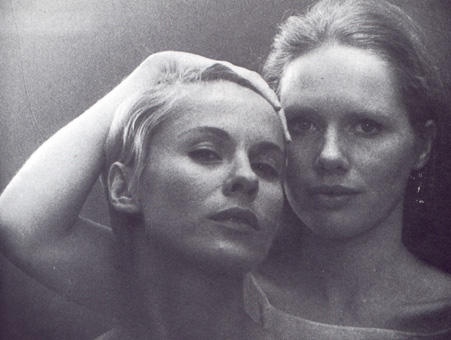
Bergman always commented that his movies are basically poetry in images. As my favoritism, Persona proves that most. Persona is a pristine blend of real intellect and illustrative metaphors. From the standpoint of Elisabet, she used to maintain her Persona throughout her life (that’s what we perform every day, maintain our dissimilar countenances and appearances for different paradigms) but when she wanted to disapprove she ceased all contacts with the external world, by silence. Here, silence is truth.

While Alma started reading Elisabet during the learning process, she projected herself into the other character. Truly, in our real world, what we believe in a different person is greatly due to the acknowledgment of that person, like we have estimated ourselves into their survival, wearing the Persona or the mask of the other.

Persona shows the visual brilliances where Alma is slowly getting entrapped into Elisabet, whether it is the dream sequence (with Mr. Vogler) or in the coveted sequences of monologues. Bergman’s long standing celebrated cinematographer Sven Nykvist brilliantly took continuous long close shots of the two actor’s faces, keeping each half of the face in dark and in light. As the movie progresses (may be it’s by my mistake or no matter what) I feel both the faces look similar.

The last long monologue is masterfully crafted when Alma conversed about Elisabet’s past life, the same dialogues been shot from two angles, once showing Elisabet’s face and then Alma’s. Alma talked about her personal viewpoint, comments about how Elisabet neglected her child. Then at the end, both their faces suddenly merged into one!

Bergman was privileged with these two gifted actors (Liv Ullman as Elisabet and Bibi Andersson as Alma). In the entire movie Liv Ullman uttered only few words (nothing…nothing...) and kept a Persona of torment and tragedy. Her silence as a blank is truer than anything. Bibi Andersson is remarkable and perfect as her other Bergman ventures (the seventh seal, all these women, wild strawberries etc.) in showing her mental distresses and of course in the scene while she is slithered in other persona, but trying to return.

The film starts with some very chaotic shots which Bergman left for the audience. For instance, it shows some reels of a silent movie, a spider (the spider-god from his chamber trilogy?), and a crucifixion (from his undying question on existence of god?), a kid places his hand on a blurred face of a woman (Elisabet’s son or Alma’s unborn child?) and so on.

Well the above, is my explanation. I am also wearing a Persona to think as I am.

Persona is a haunting brilliant masterpiece from the living legend.

Persona (1966)

Directed By : Ingmer Bergman

Sunday, August 14, 2005

Love is a...

Three anecdotes are in a zigzag movement. No correlation as such, no overlapping or any connection. All three stories are tied up in different threads but meet in a same shot, which approach to the viewers in different intervals. Everything finally summed up Amores Perros.

One story focuses on a young mother and her association to her brother-in-law. The second narrates about an ad-businessman who leaves his family for a gorgeous model. In the third a disillusioned ex-revolutionary, playing his criminal trade and obsessed about his daughter.

This was the introductory feature film of Gonzales Inarritu and no doubt he mastered the art of visceral excitements and cinematic dynamism in his earliest. It never pauses to hold a viewer's concentration, simply as a result of the pulsating energy it displays and the coarse tension it manages to sustain, over two and half hours. All the three stories have a canine motif and are connected by a horrendous car accident; you can comment that’s the only bond between the threes.

The movie is pessimist; the ending of Amores Perros is depressing: no one really comes out as the winner and everybody's hopes are banished. The end shots of all the three stories are breathtaking. Octavio’s (acted by Garcia Barnal) futile wait in bus stop for his sister-in-law, Valeria (the model) in the wheel chair with her amputated leg verifies her poster in the billboard (again a futile attempt, the billboard says “disponible” means space-available), El Chivo (the revolutionary) records his last statements for his daughter, but the recorder stops before he can remark “I love you, my little girl”.

Out of the three narrations, my ballot walks off for the second story, involving the businessman and the model. Their love dies unborn, the sufferings and distresses are metaphoric with their lost dog.

Though the ambiance of the movie as a whole is grim and unpleasant; the kinetic technique of Amores Perros is dazzlingly remarkable. It is a vibrant demonstration of pure filmmaking styles: many of the sequences were edited for more than thirty times, even the screenplay was tailored with thirty six drafts in beginning!

You might feel repulsive about Amores Perros due to the rough gloomy gory detail of human life. However, that is the movie’s premier asset.

Love, as the title designated, does not triumph.

Amores Perros
(Love is a Bitch - 2000)

Directed By : Alejandro González Iñárritu

Friday, July 29, 2005

Eternity and Angelepoulos


In the past, I made some futile efforts to write about the movie – Eternity and a Day, and each time I was left with a vacant on the paper while scratching some misleading words on MS Word. Each time I felt there is still something missing in me to contact the sheer dimensions of this film; a work of fine art and every time I found myself adjusting once more before the screen, to watch poetry lifted from dreams, drifting in , which can shred all the logical existences in a day or the eternity.


I generally don't feel to talk about the plot. But Eternity and a Day leaves such a punch, I should pen down the storyline in few words. Alexandros (played by European film staple Bruno Ganz) is an aging poet, suffering from a terminal disease and destined to stay in a hospital from tomorrow. He is fated to die tomorrow or so, and we expend his final day trailing him from morning to next morning. For Alexandros, tomorrow is a meager 24 hour day or eternity! We tag along with the unfolding of the movie slowly; he meets an Albanian refugee boy and spends the day with him on a metaphysical journey. He saves the same kid when ready to be sold to foreigners. He visits the frontier of Albania looking like a Nazi camp with spectators watching while hanging on the wire fence. He speaks with Dionysios Solomos, a poet who used to pay people to acquire a word for poetic exploitation. Alexandros tracks his past, in customary intervals, he congregates with the unread letter from his wife, he meets the symbols, the signs of life and the morning comes again, for eternity.


Why the film is a stunner? Why does the film leave with such a bang into yourself that left you with relentless thinking and thinking? Is it due to the absolute performance of the actors? Or the magical theme music of Eleni Karaindrou? The poetic narration of the film? Or what it is?


The film handles flawlessly the concept of "time" and "symbols" in life. What is a day? ?Only a progression of 24 hours? The director addresses a day as a cyclic array of life, it moves round and round and while progressing, time meets with the past and present in a descriptive way. Remember, the shot where Alexandros and the boy take a trip on the bus and three bikers dressed in yellow follow them and make you feel "yes, this is the circle of life".


The bikers draw attention from Greek mythology, they are the daughters of necessity; they are the three forms of time, out of which human life is woven, past, present and future.


For an individual, the facade of "tomorrow" can be expressed in two ways, either tomorrow is an ordinary day or an eternity (since we don't know how tomorrow will last), we call for the force of "logos" to resolve this confusing situation. For Alexandros, the use of logos, the accumulation of word-wealth, brings order to his disordered world. Alexandros remains the same old ill person, but the past remains alongside him in the present day. Past events are now present in his mind. Is the time static?


The film canvasses for an eternal truth; change of appearances is a mere illusion; but the existence is one.


Alexandros, wants as many words as he can find, to make intellect of the time he spends being alive. He is equipped to buy them (words like "outsider" or "very late") and expands his freedom, freedom from the tyranny of time, from the dictatorship of death. In the spirit of capitalism, he chases the footsteps of his predecessor, Dionysios Solomos who was buying words to write the Ode to Freedom that became the Greek National Anthem. Alexandar haplessly looks for words to save him in his awe.


In the end, I believe Alexandros gained his liberty. At the dawn he was still making plans for tomorrow." Tomorrow" after all, did not appear for Alexandros until the end of time. In the final shot, still, somebody calls his name from the seaside..."alexandros"..."alexandros"... as at the beginning of the movie. Yet, again the concept of a circle of life.


Personally, without any squabble, Eternity and a Day is one of the finest movies I ever saw. It is a clever blend of poetry and theatre. Theo Angelepoulos here draws the stringent line separating the "best" directors and the "master" of movie makers.


I can't award a 10/10 for this masterpiece, perhaps it is far ahead of all boundaries of evaluations.


Mia aioniotita kai mia mera
(Eternity and a Day -1998)

Directed By Theo Angelopoulos

Wednesday, June 29, 2005

It is education time

Bad Education is a distinctive Pedro Almodóvar venture. I was predominantly fascinated in the movie for one of the front men, Mr. Gael García Bernal. I was captivated by Bernal in Amores Perros and in ‘course The Motorcycle Diaries (in the very demanding role of Che Guevera). Surely, Bernal once more amazed me in his triple tasks of Ángel/Juan/Zahara in Bad Education. Mind that, all three persons were unusual in all logics; additionally the role of Zahara was too intricate as an imaginary transvestite.

The opening credit of the movie will surely strike a chord for you of a-la Hitchcock's Vertigo style with some dazzling color flows into the screen. Gradually, the complexity of the story turns you on, where you will see all of past, present and fictitious scenes are jumbled in a string but skillfully edited. The followers of David Lynchs’s Mulholland Drive can share to the surge of the movie, especially in the scenes of Zahira.

The movie is good quality, but I have a void in myself (personal link up, you see!!!). The mislaid linkages revealed little earlier than I anticipated (almost identical problem as in 21 grams). This left me with little hmmmm. Otherwise, it’s a must watch, but not for the homophobic crowd.

I know it will be little over reacting, but I can’t take a hiatus myself in mentioning Mr. Bernal once more. He is dazzling, remarkable, powerhouse in a sentence. He is multi-dimensional and can do anything in a wink of an eye.

Way to go man!

For the plot you can surrender towards IMDB. I am too lyad to write the same.
Mala educación, La( Bad Education - 2004)
Directed By Pedro Almodóvar