Monday, October 30, 2006

Alienation & the Millennium

Though the hole was made in ’98 the story narrated the last few days of the previous millennium, in Taipei. A bizarre virus has spread like epidemic (scientists coined – Taiwan fever) and the government is taking harsh steps to quarantine the suffered ones. The media is encouraging the uninfected people, who are living in the danger zones of Taipei, to evacuate their houses and to move into temporary arrangement planned by the government, till the spread of the virus is controlled. But there are a number of residents who are uninterested in moving out, so as a last resort to vacate those buildings, the government has threatened the residents to shut down the water supply and garbage disposal service from the beginning of the New Year.

The protagonist (Lee Kang-sheng) of the movie, a young man (a grocer by profession) lives in a shady apartment in the hazardous sector of the city. The other protagonist, a young lady (Yang Kuei-mei) lives just down below his apartment. Both are reluctant to move, knowing that the virus has crippled the lives of the city. One morning a plumber comes to the grocer’s apartment searching for the source of a water leak in the apartment downstairs. The grocer goes out for his job, after his return discovers that the utility worker has left a drilled circular hole in the concrete floor; the one unraveling his and the woman’s apartment below. Initially this hole becomes an apparatus for sort of peeping into a mysterious territory for the man, watching the woman piling toilet papers, mopping the floor from watering walls or eating Chinese noodles. Mutually they feel irritated by this convenient but weird method of observation; an estrangement breeds (the man uses the hole as ashtray, the lady sprays cockroach repellent through the hole replying this act) but sooner as the oppressive weather and the catastrophe continues to hit their mind and spacetime, the hole turns out to be the last standing channel for communication, the final hole for contacting another human life.

Tsai Ming-Liang is a prominent powerhouse representative of the second new wave of Taiwan film cradle (post Hou Hsiao-hsien?). And personally, I feel the hole as a very innovative and modern piece of art, a cross movie between Liang’s perennial pessimism about the “economic miracle” of Taiwan & isolation between urban lives but presented with a sci-fi odor and a savor of typical Hollywood musicals. Indeed the movie is continuously stroked by song-dance sequences (songs of 50’s Hong Kong staple Grace Chang), especially to reflect the inner mood of Yang. Liang used an innovative brush of contrasts (the slapstick song-dance epochs) to fill the ever depressing and soggy nature of the movie/Taipey, the extended silence of the outer world (except unremitting sound of rain) thus hitting the reality with the opposite style. I personally favored the song on “sneezing”. Yang is slowly catching the fever, the syndromes of the fever (unusual longing for damped weather, cockroach like crawling on the floor) are getting acute, and she is “sneezing” repeatedly, but the melodramatic unlikeness is making her believe that may be a school of guys thinking of her and vying for her attention.

The hole is a slanted reflection of the industrial urban life. The vigor of isolation between human lives is becoming terrible, forcing mankind to creep into the future. The hole remains as the metaphor, may be the bond to the unknown world, the future. The world is getting claustrophobic but inspite of the oppressive nature it still makes Yang fantasize about the anonymous person of the floor above. I feel rather this positive desire forced Liang to create a connection for our primal needs; in the last scene Lee passes a glass of water to Liang through the hole and aids the feverish woman with a pull, a pull towards the next millennium.

Tsai Ming Liang is original.

Dong (the Hole - 1998)
Directed By: Tsai Ming-Liang

Thursday, August 24, 2006

Conversation with the Dead

I was eagerly waiting for the DVD release of Herbert (directed by prolific theater person Suman Mukherjee, incidentally Herbert is his debut venture into big screen), not due to the political meddles it created while releasing in Calcutta (last year) but due to the sheer information that I was absolutely blown away by the original novel (winner of Sahitya Akademy award, circa ’97). Herbert is something which I never read before; the aboriginal dialect, layered unfolding, an implicit carnival spirit…

The protagonist Herbert is a person outside our mundane matrix. At times he is the simplest, possessing a golden heart but with a complex thought processing (similar to the story telling) leading a quixotic life. Herbert belongs to a deceasing north Calcutta family (families inheriting a babu traditions) where cultures, values and lifestyles are shattering day by day. In incessant flow of flash back & flash forward visuals we see how Herbert enjoying a lavish birthday party (why his name is Herbert? his father answers that he could have been Humphrey as in H. Bogart) and in the subsequent scene we see how Herbert is celebrating his birthday with cheap liquors and the local goons, today. Herbert is stranded in a desolated island, where his existence in the world is simply unworthy. He is orphaned, neglected and brought up in charity in his uncles debauched family. He has lost everything, everything he loved in his life is/was snatched and finally Herbert found his solace in communicating with the *dead ones*! The contact helps him elaborating the *business* (some elegant process of communicating with the dead souls) until the rationalists (mimicking the rationalist society of Bengal) threaten him for this counterfeit deed, declare him a fraud and eventually Herbert commits suicide.

Herbert’s life is centered on the small room in terrace and by flying kite. Director Mr. Mukherjee has brilliantly captured the changing faces of people with the backdrop of Calcutta; socially and politically. Herbert goes to see Battleship Potemkin with his leftist uncle (the role of his naxalite cousin is one striking role in the movie) and in the turbulent ‘70s bengal the Odessa steps resembles the steps of Presidency College. We see how dish antennas are replacing pigeon holders in the terraces, karate classes are mushrooming and replacing the evening roadside caroms; all are such minute subtle but sturdy details of the north calcuttan lifestyle, u need to be there....

I read elsewhere that Mr. Nabarun Bhattacharya, the author of Herbert is fascinated by the carnival spirits of story telling; what I really appreciated is that Mr. Mukherjee also was very aware of this fact (scene – Herbert’s death procession, his mom mourns but his daddy remarks – why are you crying? Are you not watching a carnival?). The movie is shot behind the camera of his father (enlightened one will find a Brechtian connection).

The layered story telling is something little weird, but not due to the complexity of the narration, the narration is actually flawless and an amazing editing table really did a great justice to make the movie easier. An explosion takes place while Herbert with his dead bed enters the electric cremation chamber. This unbelievable occurrence hits the media as a posthumous terrorist act, and a top-level investigation is launched to expose the mystery behind. The police hunt relentlessly the connection between Herbert and any terrorist organization but finally end up in delving nothing. The complex desolated life of Herbert finally stays untouched for our everyday civilization. Charlatan or Clown? Innocent or Insidious? Terrorist or Trickster? No rationalist organization with their sheer truth seeking tongues (“Stalin is the best therapy for the ones communicates with dead”) has the final answer....

Herbert (2005)
Directed By - Suman Mukherjee

Friday, July 21, 2006

Adrift in the Cosmos

Corinne: Didn't you heard what he said? Marx says we're all brothers!
Roland: Marx didn't said that. Some other communist said that. Jesus said that.

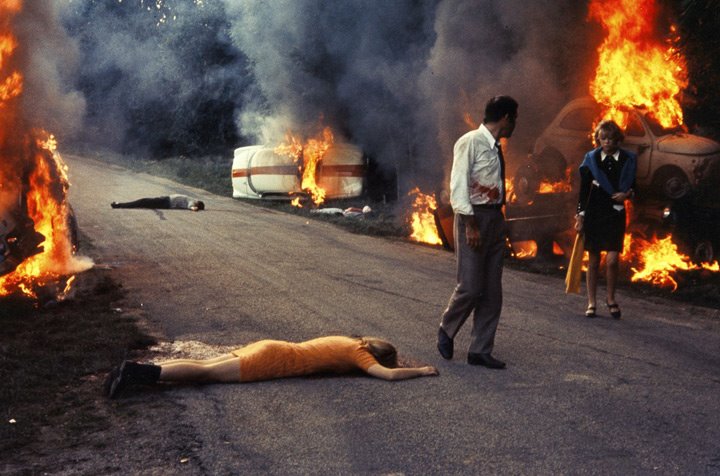
By far, weekend is one of the meanest of all movies (Gummo as a close second :)) I ever enjoyed! It distressed me, troubled me a lot and most of the times…made me frustrated, because weekend is an amazingly arrogant and self-opinionated movie. Godard cherishes breaking the rules but in weekend through minuscule details he proved how meticulously one director can arrange a *carnival* (for the sake of a movie) to split off all possible conventions of movie making; whether it’s the narration, the slices of french history, the insane bombs of discourses on the screen, amalgam of marx and pop, the random deaths of Parisian bourgeois…you just name it!

Corinne (Mireille Darc) and Roland (Jean Yanne) is a detestable parisian couple irked with each other (both have lovers (?)) and waiting for the death of Corinne’s rich father to possess the inheritance. Both confessed plans to their respective lovers to murder the other as soon they collect the money out of Corinne’s family. They made a scheme to drive to the suburban home of Corinne’s parents to accelerate the death of Corinne’s father. Little they were aware of what mammoth bizarreness was awaiting for them in the trip.

Almost immediately after the couple begins the weekend trip on the sports car, they get into a proverbial “surreal” weirdest traffic jam…a virtually ten minute long tracking shot of a country road clogged with cars and corpses, accidents, endless honking, pastime games, class struggles, tractor killing a sporty fiancé and what not! The couple meets a French revolutionary hero Camille Saint (portrayed by my favorite Jean-Pierre Leaud) and poet Emily Bronte (whom they set on fire), listen to Mozart sonatas on a grand piano in a firm, get lectured on Marxist ideas on third world politics by a garbage man and finally pressurized to join a group of hippie radicals (who living in woods and the leader of this cannibals plays drums in middle of the jungle).

I must confess here that I could not grasp succinctly all the aspects (and all what were happening) of the film. At times I did feel that Godard is trying to pitch all his anti-bourgeois proposals with a mannerism. But with his sheer talent of movie making, whatever came to his head also became a part of his own class. I deeply regard the comment of Ray on Godard; in order to turn convention upside down, one needs a particularly firm grip on convention itself. This Godard had, thanks to years of assiduous film studying at the Cinematheque in Paris. (From – Our films their films)

For anyone interested in bit of historical anecdotes, Weekend was Godard’s farewell movie for this ordinary world (I doubt if he really had any absurd dream of hitting the box market with his earlier movies) before devoting himself in movie making with the Dziga Vertov Group (producers of low budget movies without mostly any commercial ambition). But in spite of all the bizarreness weekend does a classic cinematic adventure resembling a carnival trip. It is a fusion of partly anti-bourgeois ethics and deep leftist propaganda with a layer of bizarre surrealism. Watch it at your earliest.

Week End (1967)
Directed By : Jean-Luc Godard

Monday, March 6, 2006

Sublime Anarchism

Elephant is based on an ordinary high school in USA. The film is shot in a school in Portland, Oregon (Oregon high school) but this can be any other school in any other day. The story follows few school students (they are all amateur actors, took their actual names in the movie and choose their own wardrobe with improvised dialogues; in gist Gus Van Sant provided total independency for the casts) talking mundane stuff, a student with a drunk father, socially cool and punk couple, girls are eying “cute” football player, a photographer, a girl ashamed of changing shorts in locker-room, students discussing about visual discrepancies between straight/gay couple, a physics class etc. All these incidents are very regular and routine wise prior to an anarchism which is going to take place.

Elephant is motivated by the firing spree incident took place in Columbine high school, Colorado in 1999. The killing massacre by two school students shocked the country at large and instigated the media with a massive play (for example, Michael Moore with his Bowling for Columbine documentary). The media had their own explanations of the gory occurrence (disintegration of family values? militarism? lack of gun control?) but Van Sant did not try to provoke any of the reasons. Rather, he did not give any clarification of the fictitious anarchism fabricated in the movie. Instead he refused to tender easier clarifications for what he believes are horrifying events that are better left without solutions. Sant deliberately handled the open ended story which emerges as a profound sense of estrangement and unavoidable behavior of its loose and desperate characters.

I was wondering about the title of the movie. After little googling I found out “…In other words the problems of high school students should be as hard to ignore as an elephant in a bedroom, but they're also as easy to mistake as an elephant being examined by blind men. Therefore Van Sant believes that we never really know what we are touching in our lives, and such random acts of violence that continue to plague us in our culturally ruptured society cannot be answered simplistically as most critics readily do in order to fit their own preconceived agendas…

I was particularly captivated by the "sublime" detachment of Elephant. In the opening scene we observe a blue sky changing the shades; we observe cheerful fall colors. The last night, before the shooting fling we notice the same sky, now getting darker with cloud. This aloofness is again demonstrated by the killers. Just after playing Beethoven’s “Für Elise” they seem to be obsessed with Nazi propaganda in TV and in buying guns from the internet. The guns are actually not for practice, yet to shoot their fellow friends and faculties (they have meticulously planned the attacking). Van Sant crafted a nice minimal method to tackle these.

The cinematography is structured in loops. The camera follows the characters around the school (ah! the long corridors) in an elegant fluid path. We see many a crossroads of the characters in the trajectories of the tracking camera, the story changes its navigation from face to face and often comes back to the same character in a time slice, the camera changes it's focal point between faces, often we a similar scene (how can I forget those sudden jerks of slow motioned shots!) being shot from different angles and different person’s perspective. We observe the characters are intrinsically linked together through the long labyrinthine corridors and rooms. Unfolding of the story is really brilliant with this kind of cumulative and powerful impacts.

Elephant is a deeply disturbing, strange and uncomfortable portrait of the recitation of a modern day blood massacre. The treatment is softer which makes the whole thing (the Elephant?) more shocking.

Thus a killer aptly utters before the massacre - the most important thing is to have fun!

Strictly recommended.

Elephant (2003)
Directed By : Gus Van Sant

Monday, January 30, 2006

Stranger than Fiction

Discovering Jim Jarmusch is always much fun. This might be due to the stock of black humors, the obscure angle to the society and most profoundly his sense of minimalist to the core that he possesses inside every reel. Well Stranger than Paradise is much above all these points, perhaps that’s why delving into the movie was more enjoying.

Eva flies from Hungary to meet her cousin and to stay few days before she is shifting her base to Cleveland. Her cousin Willie is a self styled New York hipster by attitude and throws quite an undesirable welcome to Eva. But then, from an epoch of hostility and initial indifference a strange affection grows between the cousins. They both exchange gifts before saying a good bye to Eva (though she did not like the NYC-trendy dress). After a year Willie and his mate Eddie (one more hipster with an interest into Eva) following a hefty win in a card game decide to come over their boredom and to travel Cleveland to visit Willie’s old aunt Lottie and of course Eva (who is then working in a food chain). While coming back from the wasteland and snow clad Cleveland both guys decide to travel the paradise on earth that is sunny Florida. They take Eva with them and move on the journey to follow stranger incidents.

The perspective of the film is reflected from the three protagonists of the movie. Eva in one hand is expecting a sense of adventure and variation in every day life; from the starting gun we see her walking in the streets of NYC with playing a tape of Screamin' Jay Hawkins' "I've Got a Spell On You”! We see her relentless trying in coming out of the monotony of life (whether suggesting many a times “"It's Screamin' Jay Hawkins and he's a wild man, so bug off" or doing at least some activity within the dark and odd lifestyle of Willie by doing vacuum cleaning!). Willie in the other hand lives an epitome of utter loneliness. He does want the change, but not conscious about how to win it! We see repeated shots of smoking many Chesterfields, watching television, eating American diner (perhaps best explained in his comment “You got your meat, you got your potatoes, you got your vegetables, you got your dessert and you don't have to wash the dishes - this is how we eat in America!”) playing solitaire, visiting Aunt Lottie and doing repeatedly everything same. Jarmusch implicitly asked the audience, is he representing the life style of the whole generation? The third guy, Eddie is again a personification of detail world-weariness of an average American. He has never been to anywhere (say Cleveland or Florida) but makes reasonable comments; is he also looking for changes as we all?

Jarmusch shot the film in black and white, with a certain time gap between all scenes. The dullness of the nature or driving long tedious snowy road is all symbols to express the same as the standpoint of the characters. The best shot from my perception is when all three try to visit the Lake Erie in Cleveland. They have to visit the same, as this is only one famous thing in Cleveland was known to them (to bring changes?) but being winter, there is nothing to see but a great expanse of snow and ice extending to the fatal gray horizon. This is such a tragic shot which expresses how human being are bound to find changes but nothing works in the backdrop of our gray life; though shot in an alter image of comic, this explains Jarmusch’s great command in making. Also one more shot to remember, when Willie buys three sunglasses the time they reach Florida; Jarmusch is brilliant in depicting that how such an insignificant bustle is important in the story line to illustrate changes in life.

See the ending of the movie for the stranger events; this is a minimal solid effort from Jarmusch. This is highly cited as one of the most deadpan comedies ever made! Stranger than Paradise is a highly recommended black and white gem.

Stranger than Paradise ( 1984)
Directed by : Jim Jarmusch