Tuesday, March 27, 2007

the Subtle Dangerous game..

In the opening scene of the film Pornography we observe that a polish middle aged artist (Frederic) returns to German occupied Poland after a long time. He is carrying a suitcase (which contains everything and nothing – paradoxically), sitting idle with few polish intellects, smoking and waiting listlessly for the end of the extended war. His close buddy, the writer friend Witold (who is also the narrator of the movie) was planning to visit the country firm of his friend Hippolyte and thus insists Frederic to come along for the trip. Pornography is all about Frederic's stint in the country side and his involvement in a dangerous and perhaps a sort of an inhumane deed.

Bored by the tranquil inactivity of the village life and by the dull routines of Hippolyte's family, Frederic masterminds a risky game between Henia (Hippolyte's teenage daughter) and Carol (a firm boy who also works in the stable); he plans to bring them together as lovers. He arranges every single possible meetings between them, prepares a theatrical romantic circumstance between them (informing them as it's just a rehearsal of a drama) and to make the situation more complicated he insists Henia's fiancé to watch this romance secretly, thus to create a faction between him and Henia. But as the movie unfolds, we find out Frederic's dark past and learn that all his present bizarre actions are actually the resultants of his feelings of guilt about his lost daughter.

Pornography is based on the novel of noted Polish author Witold Gombrowicz by the same title. As I found out form other sources, critics pointed out that the movie plot is pretty much digressed from the original novel. Such as, the character of Weronica, the teen-aged servant girl who evokes the memory of Frederic's lost girl is missing from the novel. Frederic manipulates the juvenile minds of Henia and Carole not only to fall in love but also to take part in a political murder. The consequent toying with the feelings of the others, the recklessness seems to be just a process of hurting himself, to nurture the evil inside Frederic who is deeply depressed and thus a method to prevent him from forgetting his own mistakes.

Kolski represented the war affected Germany occupied Poland in a very sublime way. We don't miss the horrified faces of polish people hiding underground nor we miss the political conflicts between the underground resistance and the army; but all are very subtle. The photography is in particular yellow-green colors and often follows isolated behaviors of animals and insects. Though the treatment of the objects (instincts, animals and human beings) is very soft, Pornography reveals the war-time depressions very cleverly. With repetitive comparison shots between the wartime politics, politics in corrupting naïve minds and the unexciting studies of the animal kingdom, Kolsky reinforces the anxiety of a very difficult time in mankind's history.

Pornografia (Pornography -2003)
Directed By :Jan Jakub Kolski

Tuesday, March 20, 2007

Life Caught in the Frame

"People are obsessed with cancer and heart trouble. My disease is work, phone calls and appointments."

The first and only colored scene in the movie illustrates two women (Cleo and a tarot reader) sitting on opposite sides of a card table, while the tarot reader foreseeing Cleo's future. The camera concentrates on the laid cards, and the cards display a premonition of something tragic might happen. The film then slips back to black and white for the rest.

Cleo, a young pop singer waiting for her results from a cancer test (she has to call the doctor at 7 o' clock in the evening for the biopsy report) and the movie reveals her story between five to seven in the evening. The film is almost a real-time description of this two hour in her life; it is around 90 minutes long but pretty much close to the fixed time frame. This is a crucial two hours in Cleo's life and the director (Agnes Varda) meticulously and beautifully crafted the story; Cleo's wandering in the streets of modern Paris, her narcissist behavior and most prominently how she is learning about the true essence of life during this hours. The film is marked by chapters (same as many French new wave films) and emphasizes the progression of time by captions.

Agnes Varda, a prominent figure of the French new wave movement (along with coveted names like Godard, Trauffaut or Rivette) typically displayed a tendency for flat narration with amalgam of reality and clever symbols. Truly the film is very rich with symbols and there are so many thought provoking incidents in the film; capricious Cleo wearing black glasses in the restaurants and searching if people can identify her, opening her pop-singer's wig to disclose her natural self beauty during her sad ness, narrating to her friend (that Cleo might be a victim of cancer) in a dark tunnel, the collective psyche of the city life in Paris; building, staircases, art students, how the passerby observing the main protagonist (here, Cleo) such as they are suggesting to open herself to the world and how everything can be referenced back to the collective contemporary culture in a nutshell, a typical film inside a film (Godard and Anna Karina did a cameo) which critics say – served as a mechanism to pick Cleo up out of her self-obsession and move forward.

Somehow from the center of the film, you will feel a strong resemblance between the protagonists Cleo and Nana in Godard's masterpiece "my life to live". But where as, Nana drags more sympathy from the viewers through the development of the film and Cleo does not, Varda herself is much more sympathetic to Cleo than Godard was to her Nana. Personally, I feel this is again a striking dissimilarity in both the films in treating the main character. May be this is due to the dissimilarity in attitudes of the both directors towards the characters in general.

If you feel interested, also watch Vagabond by the same director. You won't be disappointed.

Cléo de 5 à 7 (Cleo from 5 to 7 -1961)
Directed By :Agnes Varda

Thursday, February 8, 2007

to the Other World...

William Blake (Johny Depp) is an accountant by profession. He is traveling from his hometown Cleveland to the western city of Machine to join a steel factory. Blake’s parents are dead and he is in desperate needs of a job. Unfortunately is not aware of the fact that the job position has already been filled. Depp comes across a former prostitute beside a dingy bar in a muddy street at night. The woman, a paper flower seller insists Depp to come with her. This woman had an affair with Mr. Dickinson’s (the fowl mouth steel merchant) son and soon unhappily the night gets tinged with gunfire between all of the three. Both the merchant’s son (his name is Charles) and the woman is killed, Depp with a fatal wound escapes with Charles’s horse. Mr. Dickinson puts a hefty price on Depp’s head and hires three qualified murderer to bring him back dead/alive (firstly – he has stolen the prized horse, secondly – murderer of his son and thirdly – probable murderer of the woman). The Next morning, Depp meets an aboriginal Indian (named – Nobody) in the jungle who mistakes Depp as the original Blake (as in the poet) and from this point on, Depp’s journey begins. In other words I can put this as – the journey of one of the longest and beautiful death sequences in movie records.

Not surprisingly Dead man is a B&W film (Jarmusch’s major ventures are shot in B&W - stranger than paradise, down by law, coffee and cigarettes) but the interesting fact remains that dead man has a western charm (or, neo western) and the movie is all about Depp’s reallocation from the western planet to the other side, say the native world. Culture clash or fights between different paradigms has always been a prime motif of many westerns and Dead Man is no exception but certainly with a twist. From the very beginning we see that Depp is not appropriate in the big-picture of the movie (he is polished, sober, clean outfit, round spectacle – diametrically opposite with his fellow travelers in the train or the city of Machine residents) and by little by little how he is trying to fit in the spiritual stance of the movie. I can recall a beautiful shot in beginning: - Depp is mostly sleeping in the train and with every single crack he watches how the fellow passengers and the nature outside the window are changing. He is sober, polite, no action hero but quicker he is getting the taste of blood in his hands with sporadic killings. I think Jarmusch draws this allegory with the theme of “violence in poetry” and fascinatingly used the metaphor of William Blake.

The name Nobody surely gives a budge; he is nobody and so can be anyone to guide Depp. Jarmusch meticulously planned this character to give a wider characteristic, to give a taste of an open world but closer to nature. That’s why the dialect of Nobody is a mixture model of various American Indian clans!

Dead man is all about a journey en route for a spiritual uplift of Depp. It is a lonely expedition of a wounded man who will be dead soon. Remember from the very beginning how Nobody (who seems to be almost a scholar) helps Depp in preparing him for the journey. Nobody is more interested in healing Depp’s western soul than his wounds. Being with Nobody, traveling through the woods, meeting and facing merciless fates Depp is a learner here. The film and Depp both gradually transit to a native terrain without any “intrusion”. His physical condition is worsening; his eyes are just open to see the fragility of the cruel world that defines the realms. There is no explicit camera trickery or motivating speech or preach yet the transition is sleek and very smooth.

In the ending we observe Blake’s solo voyage into the sea where his death is waiting, a lone ornamented boat is drifting away with him and suddenly we realize our regular so called refined world is such temporary and short-lived.

Dead Man - 1995
Directed By : Jim Jarmusch

Monday, October 30, 2006

Alienation & the Millennium

Though the hole was made in ’98 the story narrated the last few days of the previous millennium, in Taipei. A bizarre virus has spread like epidemic (scientists coined – Taiwan fever) and the government is taking harsh steps to quarantine the suffered ones. The media is encouraging the uninfected people, who are living in the danger zones of Taipei, to evacuate their houses and to move into temporary arrangement planned by the government, till the spread of the virus is controlled. But there are a number of residents who are uninterested in moving out, so as a last resort to vacate those buildings, the government has threatened the residents to shut down the water supply and garbage disposal service from the beginning of the New Year.

The protagonist (Lee Kang-sheng) of the movie, a young man (a grocer by profession) lives in a shady apartment in the hazardous sector of the city. The other protagonist, a young lady (Yang Kuei-mei) lives just down below his apartment. Both are reluctant to move, knowing that the virus has crippled the lives of the city. One morning a plumber comes to the grocer’s apartment searching for the source of a water leak in the apartment downstairs. The grocer goes out for his job, after his return discovers that the utility worker has left a drilled circular hole in the concrete floor; the one unraveling his and the woman’s apartment below. Initially this hole becomes an apparatus for sort of peeping into a mysterious territory for the man, watching the woman piling toilet papers, mopping the floor from watering walls or eating Chinese noodles. Mutually they feel irritated by this convenient but weird method of observation; an estrangement breeds (the man uses the hole as ashtray, the lady sprays cockroach repellent through the hole replying this act) but sooner as the oppressive weather and the catastrophe continues to hit their mind and spacetime, the hole turns out to be the last standing channel for communication, the final hole for contacting another human life.

Tsai Ming-Liang is a prominent powerhouse representative of the second new wave of Taiwan film cradle (post Hou Hsiao-hsien?). And personally, I feel the hole as a very innovative and modern piece of art, a cross movie between Liang’s perennial pessimism about the “economic miracle” of Taiwan & isolation between urban lives but presented with a sci-fi odor and a savor of typical Hollywood musicals. Indeed the movie is continuously stroked by song-dance sequences (songs of 50’s Hong Kong staple Grace Chang), especially to reflect the inner mood of Yang. Liang used an innovative brush of contrasts (the slapstick song-dance epochs) to fill the ever depressing and soggy nature of the movie/Taipey, the extended silence of the outer world (except unremitting sound of rain) thus hitting the reality with the opposite style. I personally favored the song on “sneezing”. Yang is slowly catching the fever, the syndromes of the fever (unusual longing for damped weather, cockroach like crawling on the floor) are getting acute, and she is “sneezing” repeatedly, but the melodramatic unlikeness is making her believe that may be a school of guys thinking of her and vying for her attention.

The hole is a slanted reflection of the industrial urban life. The vigor of isolation between human lives is becoming terrible, forcing mankind to creep into the future. The hole remains as the metaphor, may be the bond to the unknown world, the future. The world is getting claustrophobic but inspite of the oppressive nature it still makes Yang fantasize about the anonymous person of the floor above. I feel rather this positive desire forced Liang to create a connection for our primal needs; in the last scene Lee passes a glass of water to Liang through the hole and aids the feverish woman with a pull, a pull towards the next millennium.

Tsai Ming Liang is original.

Dong (the Hole - 1998)
Directed By: Tsai Ming-Liang

Thursday, August 24, 2006

Conversation with the Dead

I was eagerly waiting for the DVD release of Herbert (directed by prolific theater person Suman Mukherjee, incidentally Herbert is his debut venture into big screen), not due to the political meddles it created while releasing in Calcutta (last year) but due to the sheer information that I was absolutely blown away by the original novel (winner of Sahitya Akademy award, circa ’97). Herbert is something which I never read before; the aboriginal dialect, layered unfolding, an implicit carnival spirit…

The protagonist Herbert is a person outside our mundane matrix. At times he is the simplest, possessing a golden heart but with a complex thought processing (similar to the story telling) leading a quixotic life. Herbert belongs to a deceasing north Calcutta family (families inheriting a babu traditions) where cultures, values and lifestyles are shattering day by day. In incessant flow of flash back & flash forward visuals we see how Herbert enjoying a lavish birthday party (why his name is Herbert? his father answers that he could have been Humphrey as in H. Bogart) and in the subsequent scene we see how Herbert is celebrating his birthday with cheap liquors and the local goons, today. Herbert is stranded in a desolated island, where his existence in the world is simply unworthy. He is orphaned, neglected and brought up in charity in his uncles debauched family. He has lost everything, everything he loved in his life is/was snatched and finally Herbert found his solace in communicating with the *dead ones*! The contact helps him elaborating the *business* (some elegant process of communicating with the dead souls) until the rationalists (mimicking the rationalist society of Bengal) threaten him for this counterfeit deed, declare him a fraud and eventually Herbert commits suicide.

Herbert’s life is centered on the small room in terrace and by flying kite. Director Mr. Mukherjee has brilliantly captured the changing faces of people with the backdrop of Calcutta; socially and politically. Herbert goes to see Battleship Potemkin with his leftist uncle (the role of his naxalite cousin is one striking role in the movie) and in the turbulent ‘70s bengal the Odessa steps resembles the steps of Presidency College. We see how dish antennas are replacing pigeon holders in the terraces, karate classes are mushrooming and replacing the evening roadside caroms; all are such minute subtle but sturdy details of the north calcuttan lifestyle, u need to be there....

I read elsewhere that Mr. Nabarun Bhattacharya, the author of Herbert is fascinated by the carnival spirits of story telling; what I really appreciated is that Mr. Mukherjee also was very aware of this fact (scene – Herbert’s death procession, his mom mourns but his daddy remarks – why are you crying? Are you not watching a carnival?). The movie is shot behind the camera of his father (enlightened one will find a Brechtian connection).

The layered story telling is something little weird, but not due to the complexity of the narration, the narration is actually flawless and an amazing editing table really did a great justice to make the movie easier. An explosion takes place while Herbert with his dead bed enters the electric cremation chamber. This unbelievable occurrence hits the media as a posthumous terrorist act, and a top-level investigation is launched to expose the mystery behind. The police hunt relentlessly the connection between Herbert and any terrorist organization but finally end up in delving nothing. The complex desolated life of Herbert finally stays untouched for our everyday civilization. Charlatan or Clown? Innocent or Insidious? Terrorist or Trickster? No rationalist organization with their sheer truth seeking tongues (“Stalin is the best therapy for the ones communicates with dead”) has the final answer....

Herbert (2005)
Directed By - Suman Mukherjee

Friday, July 21, 2006

Adrift in the Cosmos

Corinne: Didn't you heard what he said? Marx says we're all brothers!
Roland: Marx didn't said that. Some other communist said that. Jesus said that.

By far, weekend is one of the meanest of all movies (Gummo as a close second :)) I ever enjoyed! It distressed me, troubled me a lot and most of the times…made me frustrated, because weekend is an amazingly arrogant and self-opinionated movie. Godard cherishes breaking the rules but in weekend through minuscule details he proved how meticulously one director can arrange a *carnival* (for the sake of a movie) to split off all possible conventions of movie making; whether it’s the narration, the slices of french history, the insane bombs of discourses on the screen, amalgam of marx and pop, the random deaths of Parisian bourgeois…you just name it!

Corinne (Mireille Darc) and Roland (Jean Yanne) is a detestable parisian couple irked with each other (both have lovers (?)) and waiting for the death of Corinne’s rich father to possess the inheritance. Both confessed plans to their respective lovers to murder the other as soon they collect the money out of Corinne’s family. They made a scheme to drive to the suburban home of Corinne’s parents to accelerate the death of Corinne’s father. Little they were aware of what mammoth bizarreness was awaiting for them in the trip.

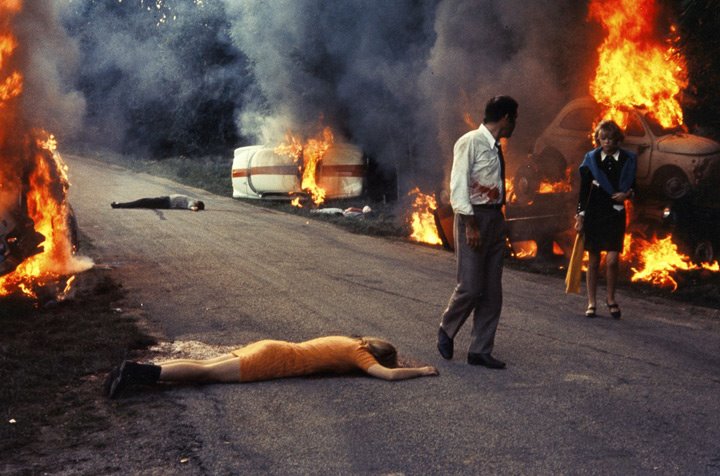
Almost immediately after the couple begins the weekend trip on the sports car, they get into a proverbial “surreal” weirdest traffic jam…a virtually ten minute long tracking shot of a country road clogged with cars and corpses, accidents, endless honking, pastime games, class struggles, tractor killing a sporty fiancé and what not! The couple meets a French revolutionary hero Camille Saint (portrayed by my favorite Jean-Pierre Leaud) and poet Emily Bronte (whom they set on fire), listen to Mozart sonatas on a grand piano in a firm, get lectured on Marxist ideas on third world politics by a garbage man and finally pressurized to join a group of hippie radicals (who living in woods and the leader of this cannibals plays drums in middle of the jungle).

I must confess here that I could not grasp succinctly all the aspects (and all what were happening) of the film. At times I did feel that Godard is trying to pitch all his anti-bourgeois proposals with a mannerism. But with his sheer talent of movie making, whatever came to his head also became a part of his own class. I deeply regard the comment of Ray on Godard; in order to turn convention upside down, one needs a particularly firm grip on convention itself. This Godard had, thanks to years of assiduous film studying at the Cinematheque in Paris. (From – Our films their films)

For anyone interested in bit of historical anecdotes, Weekend was Godard’s farewell movie for this ordinary world (I doubt if he really had any absurd dream of hitting the box market with his earlier movies) before devoting himself in movie making with the Dziga Vertov Group (producers of low budget movies without mostly any commercial ambition). But in spite of all the bizarreness weekend does a classic cinematic adventure resembling a carnival trip. It is a fusion of partly anti-bourgeois ethics and deep leftist propaganda with a layer of bizarre surrealism. Watch it at your earliest.

Week End (1967)
Directed By : Jean-Luc Godard

Monday, March 6, 2006

Sublime Anarchism

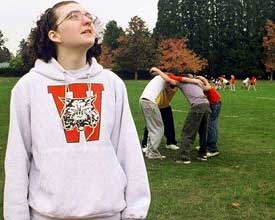
Elephant is based on an ordinary high school in USA. The film is shot in a school in Portland, Oregon (Oregon high school) but this can be any other school in any other day. The story follows few school students (they are all amateur actors, took their actual names in the movie and choose their own wardrobe with improvised dialogues; in gist Gus Van Sant provided total independency for the casts) talking mundane stuff, a student with a drunk father, socially cool and punk couple, girls are eying “cute” football player, a photographer, a girl ashamed of changing shorts in locker-room, students discussing about visual discrepancies between straight/gay couple, a physics class etc. All these incidents are very regular and routine wise prior to an anarchism which is going to take place.

Elephant is motivated by the firing spree incident took place in Columbine high school, Colorado in 1999. The killing massacre by two school students shocked the country at large and instigated the media with a massive play (for example, Michael Moore with his Bowling for Columbine documentary). The media had their own explanations of the gory occurrence (disintegration of family values? militarism? lack of gun control?) but Van Sant did not try to provoke any of the reasons. Rather, he did not give any clarification of the fictitious anarchism fabricated in the movie. Instead he refused to tender easier clarifications for what he believes are horrifying events that are better left without solutions. Sant deliberately handled the open ended story which emerges as a profound sense of estrangement and unavoidable behavior of its loose and desperate characters.

I was wondering about the title of the movie. After little googling I found out “…In other words the problems of high school students should be as hard to ignore as an elephant in a bedroom, but they're also as easy to mistake as an elephant being examined by blind men. Therefore Van Sant believes that we never really know what we are touching in our lives, and such random acts of violence that continue to plague us in our culturally ruptured society cannot be answered simplistically as most critics readily do in order to fit their own preconceived agendas…”

I was particularly captivated by the "sublime" detachment of Elephant. In the opening scene we observe a blue sky changing the shades; we observe cheerful fall colors. The last night, before the shooting fling we notice the same sky, now getting darker with cloud. This aloofness is again demonstrated by the killers. Just after playing Beethoven’s “Für Elise” they seem to be obsessed with Nazi propaganda in TV and in buying guns from the internet. The guns are actually not for practice, yet to shoot their fellow friends and faculties (they have meticulously planned the attacking). Van Sant crafted a nice minimal method to tackle these.

The cinematography is structured in loops. The camera follows the characters around the school (ah! the long corridors) in an elegant fluid path. We see many a crossroads of the characters in the trajectories of the tracking camera, the story changes its navigation from face to face and often comes back to the same character in a time slice, the camera changes it's focal point between faces, often we a similar scene (how can I forget those sudden jerks of slow motioned shots!) being shot from different angles and different person’s perspective. We observe the characters are intrinsically linked together through the long labyrinthine corridors and rooms. Unfolding of the story is really brilliant with this kind of cumulative and powerful impacts.

Elephant is a deeply disturbing, strange and uncomfortable portrait of the recitation of a modern day blood massacre. The treatment is softer which makes the whole thing (the Elephant?) more shocking.

Thus a killer aptly utters before the massacre - the most important thing is to have fun!

Strictly recommended.

Elephant (2003)
Directed By : Gus Van Sant